Start here
How backlinks actually pass value, and why most bought links don't

Most advice on backlinks ranks sites by an authority score and stops there. That is how buyers end up paying for a link on a high-scoring domain that Google never indexes, on a page nobody visits, that is gone within a year.
This guide follows a bought link from the day it is published and marks the five points where it stops being worth anything. Each point comes with its evidence, labelled by how solid that evidence is, and a check you can run before you pay.
The page holds the link, and the page is what counts
DR (Ahrefs Domain Rating), DA (Moz Domain Authority) and AS (Semrush Authority Score) are third-party scores for a whole domain. They are not Google's numbers, and they say nothing about the one page your link will sit on.
A 2026 audit by SpeedyIndex, an indexing service, makes the gap plain. The company bought 15,389 links on Fiverr and Kwork and checked every one a year later. It found many well-known, high-scoring sites keep their homepage open to search engines while closing profile pages, user posts and shared files with noindex or robots.txt rules. Sellers go on selling links on those closed pages. The audit listed 451 closed page types across 437 sites.
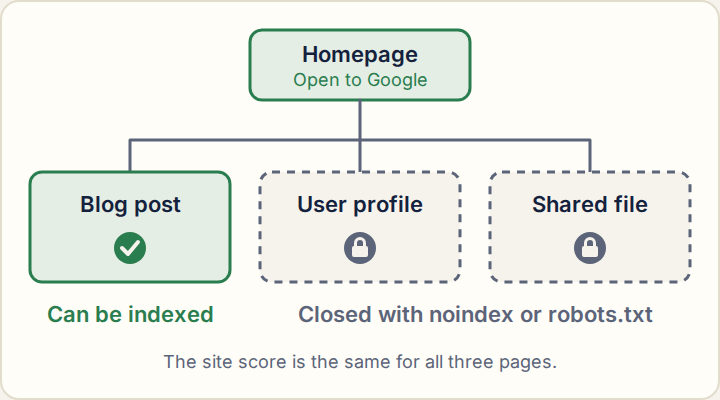
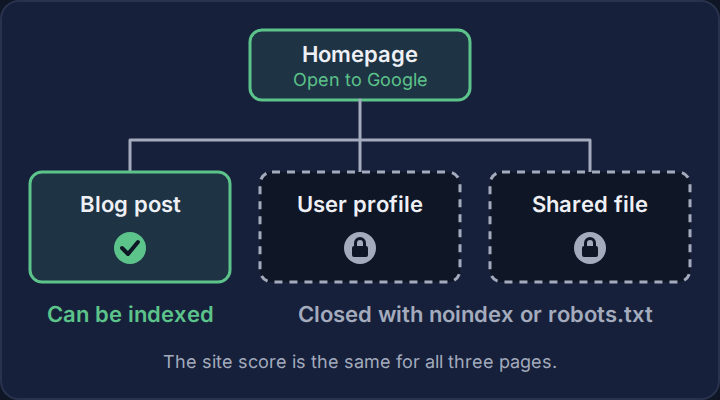
The decision rule that follows: judge the page type first, the site second, and the score last. Ask the seller for a recent example of the same kind of page, then check that example.
Five points where a bought link fails
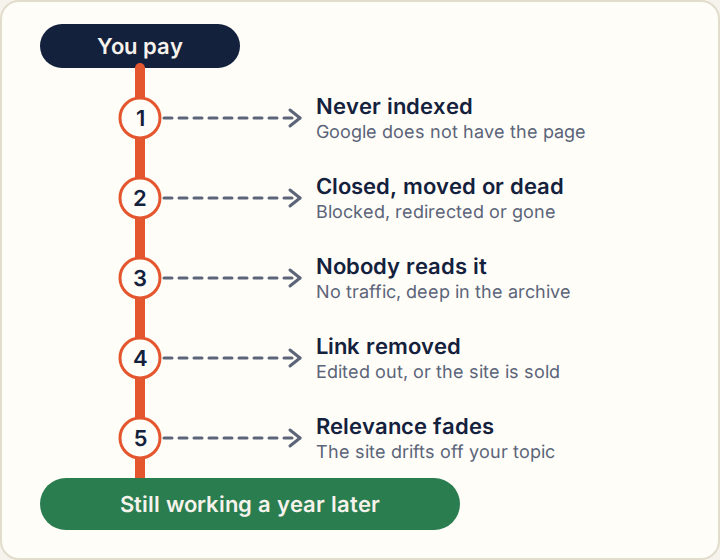
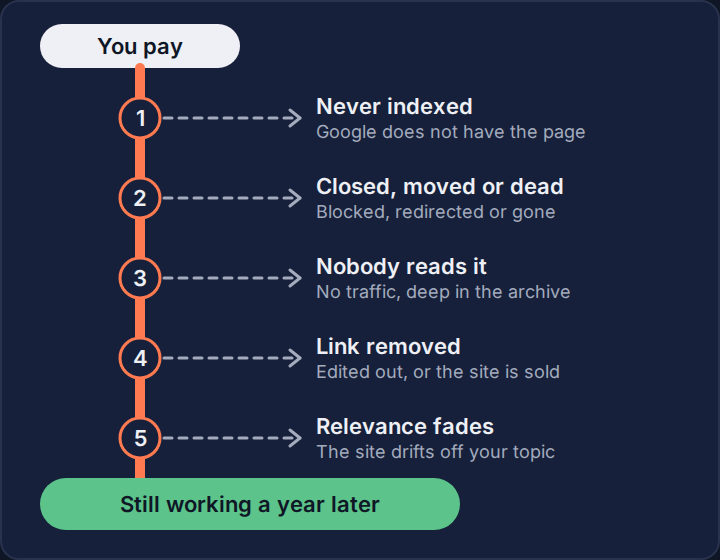
| Failure point | What happens | Check before you pay |
|---|---|---|
| 1. Never indexed | Google does not have the page in its index, so the link on it cannot count. | Search Google for the exact address of three recent posts on the site. |
| 2. Closed, moved or dead | The page is blocked from indexing, redirects somewhere else, or stops loading. | Open a sample page and look for noindex, a canonical tag pointing elsewhere, and a robots.txt block. |
| 3. Nobody reads it | The page is indexed but sits on a site with no search traffic, deep in an archive. | Pull 24 months of estimated traffic. Look at the trend, then at how far the post sits from the homepage. |
| 4. Link removed | An editor edits the post, strips the link, or the site changes hands. | Get permanence and a replacement promise in writing. |
| 5. Relevance fades | The post and the site drift away from your subject, or the post ages into the archive. | Read the 10 newest posts. If they are off your topic now, the site is moving. |
Points 1 and 2: the page is not in the index
The SpeedyIndex audit is the largest public count of what happens to cheap bought links. A year after purchase, 562 of the 15,389 links were in Google's index. That is 3.7%.
- Dead
- 33.7%
- Live and open
- 21%
- Error response
- 13.4%
- Redirected elsewhere
- 11.9%
- Behind a bot challenge
- 11.9%
- Blocked from indexing
- 8.1%
Two details matter more than the headline. Of the pages that were live and open, only 8.6% were indexed, so a page that loads fine is no proof of anything. And 93.1% of the 5,088 linking domains had no indexed link at all.
Read this study for what it is. It covers low-priced gigs on two marketplaces, and it was published by a company that sells indexing. It tells you little about a guest post on a real blog with readers. It tells you a great deal about any offer built on a domain score and a low price.
Point 3: where the page sits in Google's index
Being indexed is the floor. The evidence that some indexed pages pass more value than others comes in two grades, and neither is a Google statement. Google has not published any rule tying a link's value to the traffic of the page it sits on.
Indicated by the 2024 documentation leak
Google internal API documentation that became public in 2024 includes an attribute on links named sourceType. Analysts writing for Search Engine Land report that it records the quality of a link's source page in relation to that page's index tier, and that newly published pages are treated as a special case, on a level with high-quality sources.
The same analysts are clear about the limits. The leak lists more than 14,000 attributes and does not say how any of them is weighted, or which are used in ranking today.
Our inference
The documentation does not say what places a page in a higher tier. Our reading is that a page real people visit is more likely to sit in a tier that counts, and we treat a site's search traffic as the best outside sign of that. This is our inference. Neither Google nor the leak confirms it.
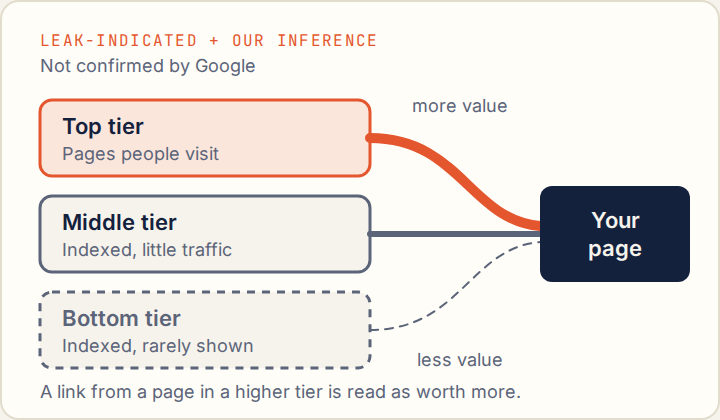
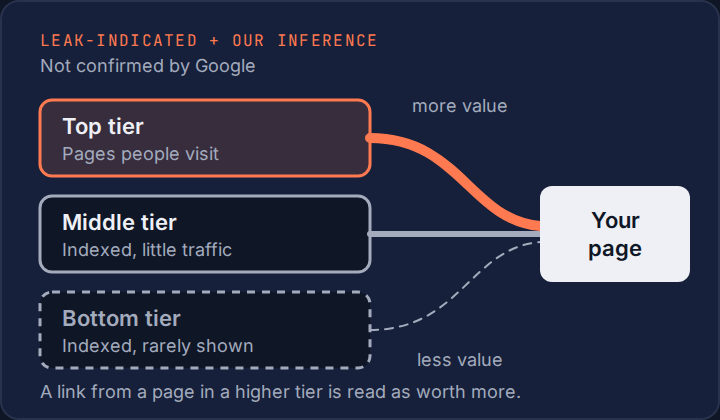
The practical rule holds whichever grade you trust: a link on a page with readers is worth more than a link on a page without them, if only because readers can click it.
Point 4: the link is removed
Ahrefs tracked the links pointing to 2,062,173 websites from January 2013. By its count, 66.5% of those links had rotted, and 74.5% were lost for ranking purposes once errors and other faults were added.
- Page or domain dropped
- 47.7%
- Link removed, page still live
- 34.2%
- Crawl error
- 6.45%
- Redirected
- 5.99%
- Not found
- 4.11%
The second bar is the one a buyer can do something about. In roughly a third of losses the page is still there and somebody took the link out. That is a matter of terms, and terms can be agreed before money changes hands. Get the seller's terms in writing and put the link on a re-check schedule.
The Ahrefs figures cover all links over about nine years, not paid placements, so they set a baseline. A bought link has every ordinary reason to disappear plus a commercial one.
Point 5: relevance fades
Confirmed by Google
Asked whether links lose value with age, Google's John Mueller said Google does not assign value by how old a link is. Value can still fall as the linking content becomes less relevant. His example was a news article that starts near the homepage and later moves into an archive.
So "link decay" is real as an outcome and unconfirmed as a mechanism. There is no known age counter. What changes is the page: it sinks deeper into the site, its topic stops matching yours, and fewer people reach it. Our guide to link decay separates the confirmed parts from the myths.
What survives when you check sites properly
Our checks are built around the five points above. We look at the traffic trend and the page types a site sells, and we ask sellers about permanence in writing. We do not rely on a domain score.
Work out what a link really costs
A price means little until you divide it by the chance the link is still doing its job a year from now.
Real cost = price ÷ (chance the page is indexed × chance the link is still live at 12 months)
The two examples below use made-up figures to show the arithmetic. They are not measurements.
| Offer A | Offer B | |
|---|---|---|
| What is sold | Link on a high-score domain, page type unknown | Guest post on a blog with steady search traffic |
| Price | $10 | $120 |
| Chance the page is indexed | 5% | 90% |
| Chance the link is live at 12 months | 50% | 80% |
| Real cost per working link | $10 ÷ (0.05 × 0.50) = $400 | $120 ÷ (0.90 × 0.80) = $167 |
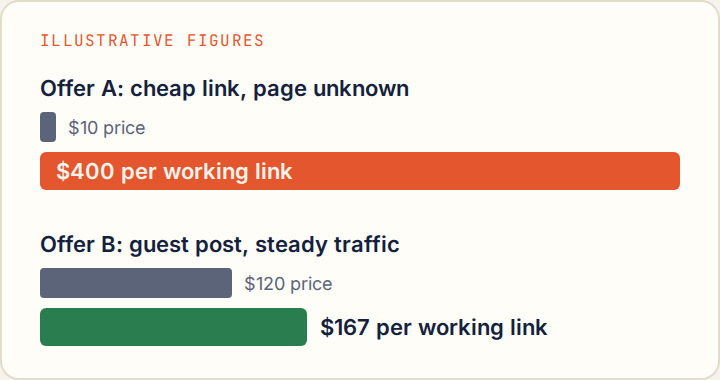
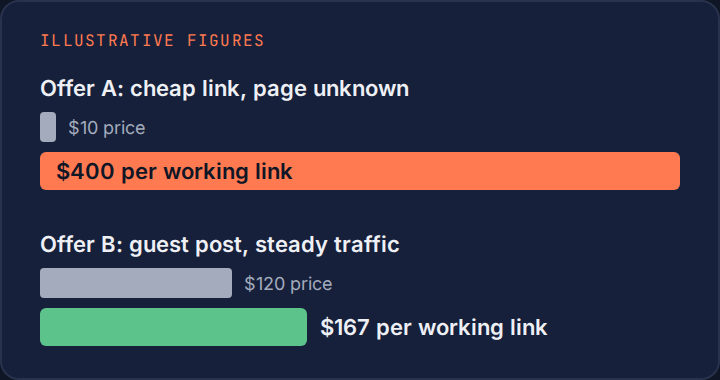
You will not know the two percentages exactly. You do not need to. Estimate the first from whether the site's recent posts are indexed, and the second from the seller's written terms and how long the site has kept its older guest posts. If you cannot estimate either, that is your answer.
Links and mentions in AI answers
AI systems such as Google AI Overviews, AI Mode and ChatGPT name brands in their answers. Two Ahrefs studies of 75,000 brands looked at what goes along with being named.
| Factor | Correlation with being named | Study |
|---|---|---|
| Brand mentions on YouTube | about 0.737 | Ahrefs, December 2025 (ChatGPT, AI Mode, AI Overviews) |
| Brand mentions on the web | 0.664 | Ahrefs, May 2025 (AI Overviews) |
| Number of backlinks | 0.218 | Ahrefs, May 2025 (AI Overviews) |
These are correlations, not causes. Well-known brands collect mentions, links and AI citations all at once, and the studies cannot say which produces which.
What a buyer can take from it: a placement that names your brand in a sentence a reader would understand does two jobs, and a bare link on a keyword does one. When you agree a guest post, ask for the brand name in the text near the link. Links versus mentions in AI search covers this in full.
Where Google stands on paid links
Confirmed by Google
Google's spam policies list buying or selling links for ranking purposes as link spam. That includes paying for posts that contain links. A paid link does not break the policy when it carries rel="sponsored" or rel="nofollow".
Google has also said that sites publishing or acquiring links through excessive sponsored and guest posts without those tags can face both algorithmic and manual actions.
A paid link without one of those attributes is a risk you choose to carry, however carefully the site was chosen. Vetting cuts the money you waste on dead and unindexed pages. It does not make the link approved. Our guide to Google's paid link policy sets out how to weigh that risk.
Every guide in this series
Vetting a site before you pay
Buying and negotiating
After the link goes live
How links work
Strategy beyond outreach
For agencies
Research
How to check this yourself
- Ask what page type you are buying. A post in the main blog, a profile, a "sponsored" section and a subdomain are different products.
- Test indexing on the seller's recent work. Take three posts from the last three months and search Google for each exact address. If two are missing, stop.
- Open one of those posts and view the source. Search it for noindex and for a canonical tag that points to a different address.
- Pull 24 months of estimated traffic. Compare the latest 3 months with the best 3. Below 30% of the peak, the site has collapsed.
- Count clicks from the homepage to a post published six months ago. If you cannot reach it in three or four, your post will be buried too.
- Get the terms in writing: how long the post stays, the rel attribute, and a replacement if the link is removed.
- Run the cost formula with your own estimates before comparing prices.
- Re-check after you buy at 30, 90 and 365 days: page live, page indexed, link present, rel unchanged.
Related guides
Sources
- SpeedyIndex study of 15,389 bought backlinks, via Cantech Letter (November 6, 2026)
- Ahrefs: link rot study
- Ahrefs: AI Overview brand correlation study (May 2025)
- Ahrefs: AI brand visibility correlations (December 2025)
- Google Search Central: spam policies for Google web search
- Google Search Central blog: link tagging and the link spam update (July 2021)
- Search Engine Journal: Google on whether link value changes with age
- Search Engine Land: links and digital PR takeaways from the Google documentation leak
Last updated Methodology