Vetting a site before you pay
Why DR and DA are the wrong numbers to buy links on

Guest post price lists are sorted by DR because it is one number, it is easy to compare, and sellers know buyers ask for it. None of that makes it a measure of what you are buying.
This guide sets out what the scores count, what they miss, what Google has and has not said about them, and what to put in their place.
What a domain score actually counts
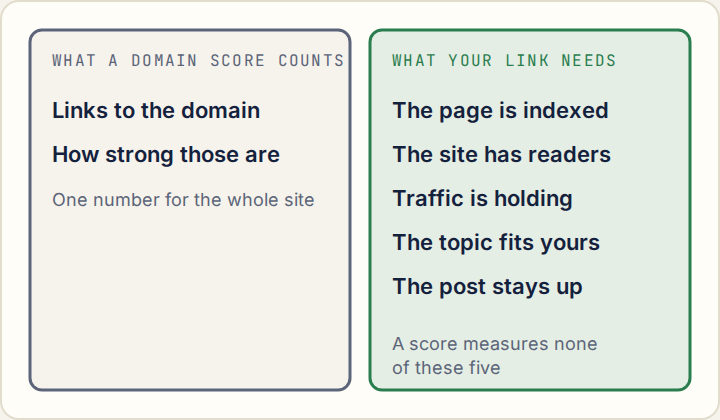
All three scores are built by the tool companies from their own crawl of the web. In broad terms they count how many other sites link to a domain and how strong those sites are, then squeeze the result onto a scale of 0 to 100.
Three things follow from that.
- They are about links in, not visitors. A site can have many old links and no readers.
- They are about the domain. Every page on the site carries the same score, including pages Google cannot index.
- They can be raised on purpose. Because the score responds to links, a seller who buys links to their own site can lift the number buyers pay for.
What Google has said, and what the leak shows
Confirmed by Google
Google's John Mueller said in 2020 that Google does not use Domain Authority in crawling, indexing or ranking. Later the same year he said Google does have some signals that work at the level of a whole site.
Indicated by the 2024 documentation leak
The Google API documentation that became public in 2024 contains an attribute called siteAuthority. The analysts who reported it doubt that it is a link-only score like DA or DR, and note that it sits among quality signals, not link signals. How it is calculated and used is not known.
Our inference
Google appears to judge sites as a whole in some way. Nothing public ties that judgment to DR, DA or AS. Treating a tool's score as a stand-in for Google's view is a guess, and we do not make it.
Why a high score survives a dead site
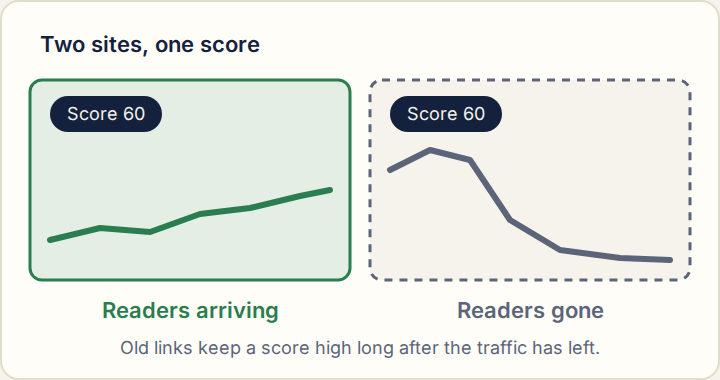
Links pile up over years and disappear slowly. Traffic can go in a few months, after an algorithm update, a change of owner or a switch to publishing anything for money. So the score is a lagging number, and it lags in the direction that flatters the seller.
That lag is the business model of the recycled domain. Someone buys an expired domain with a strong link history, rebuilds a blog on it, and sells guest posts on the strength of the inherited score. How to spot a recycled domain shows what to look for.
What the traffic data shows that a score hides
Every one of those sites was live, on topic, publishing articles and free of gray-topic content. Each would have a domain score, and the score would not tell you which group it belonged to.
The page problem
A 2026 audit by SpeedyIndex, an indexing service, bought 15,389 links on gig marketplaces and checked them a year later. On 93.1% of the 5,088 linking domains, not one bought link was in Google's index. The audit also listed 451 page types on 437 well-known sites that are closed to search engines, and on 266 of those sites the homepage itself is open.
That is the gap in one line: the domain is strong and open, and the page you paid for is shut. The study covers cheap marketplace gigs and comes from a company that sells indexing, so read it as a picture of the low end. How backlinks pass value goes through it in full.
How scores distort prices
When sellers price by score, two things happen. Good sites with modest scores are underpriced, and weak sites with inherited or inflated scores are overpriced. A buyer who sorts by DR pays most for the second kind.
The warning sign at the cheap end is a very high score at a very low price. A site with a real audience has no reason to sell a permanent article for the cost of a sandwich. If the offer is "DR 70" for a few dollars, you are being sold the number.
What to use instead
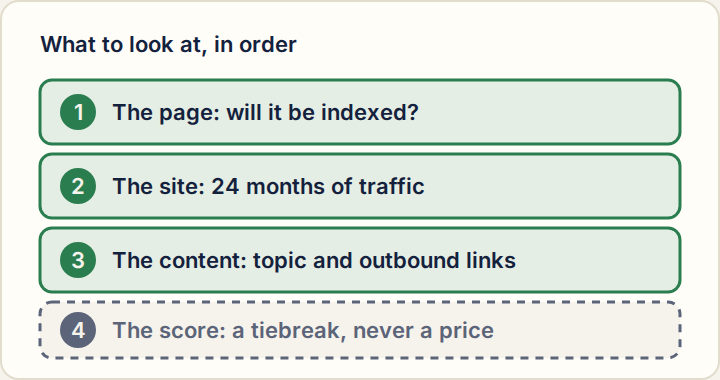
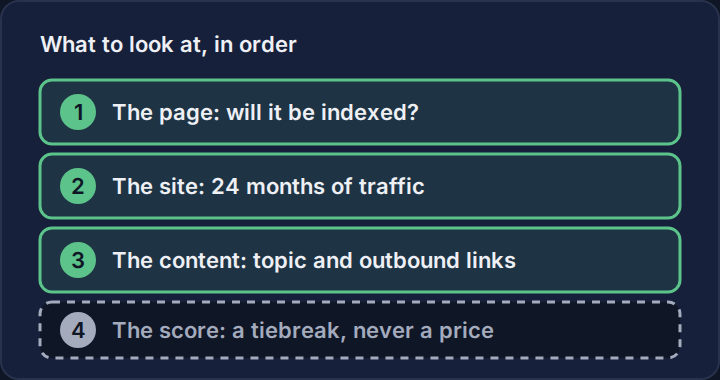
| Question | What answers it | Our line |
|---|---|---|
| Will the page be indexed? | Search Google for the address of 3 recent posts on the site. | At least 2 of 3 found |
| Does the site have readers? | Latest 3-month average of estimated Google visits. | 500 a month or more |
| Is it holding its readers? | Latest 3 months against the best 3 in 24 months. | 30% of peak or more |
| Is it still falling? | Latest 3 months against the 3 before. | Not down more than 20% |
| Is it on your subject? | The 10 newest post titles. | Most of them fit |
| Is it a link farm? | Outbound links in recent posts. | No more than 15 per post |
How to read traffic history explains the traffic lines, and the vetting checklist turns all of this into a scorecard.
When a score is still useful
- As a tiebreak. Two sites pass every check and cost the same. Take the one with more sites linking to it.
- As a quick filter for brand-new domains. A score near zero on a site claiming years of history is worth a question.
- As a way to spot a mismatch. High score and no traffic is itself a finding. It points to an old domain living on its past.
How to check this yourself
- Take the seller's list and delete the score column before you start. You can bring it back at the end.
- Search Google for three recent post addresses from each site. Drop the sites where two or more are missing.
- Pull 24 months of traffic for what is left. Drop anything under 500 visits a month or under 30% of its peak.
- Read the 10 newest post titles and count the outbound links in three posts.
- Rank the survivors by cost per 1,000 visitors: the price divided by monthly visits, times 1,000.
- Now bring the score back. Use it only to split sites that are otherwise level, and note any site where score and traffic disagree badly.
Questions buyers ask
- Is DR a ranking factor?
- No. DR is a number made by Ahrefs from its own crawl. Google has said it does not use third-party scores such as Domain Authority.
- Does Google have its own domain authority score?
- A leaked document from 2024 shows an attribute called siteAuthority. How it is calculated and whether it resembles any tool's score is not known, and Google has not confirmed how it is used.
- What is a good DR for a guest post site?
- There is no useful answer, which is the point of this guide. A site with a modest score and steady readers is a better buy than a high-scoring site that has lost its traffic.
- Why do sellers still price by DR?
- Because buyers ask for it and it is easy to compare. It also favours sellers of old or recycled domains, whose scores hold up long after the traffic has gone.
Related guides
Sources
- Search Engine Land: links and digital PR takeaways from the Google documentation leak
- SpeedyIndex study of 15,389 bought backlinks, via Cantech Letter (November 6, 2026)
- BacklinkURLs methodology
Last updated Methodology