Vetting a site before you pay
PBN and link farm red flags: a footprint checklist

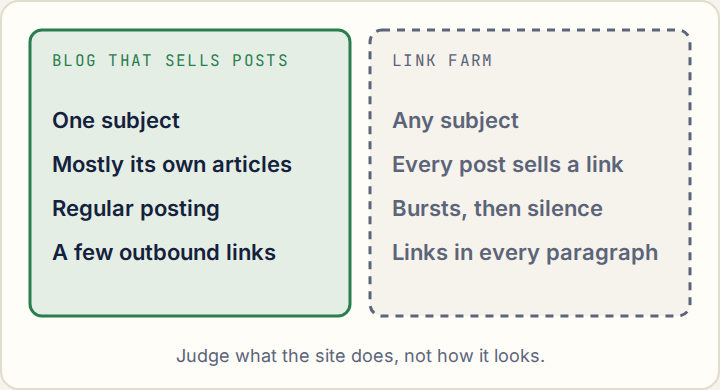
Link farms rarely look like farms. They have a logo, a tidy theme and articles with stock photos. What gives them away is behaviour: what they publish, who they link to, and how they sell.
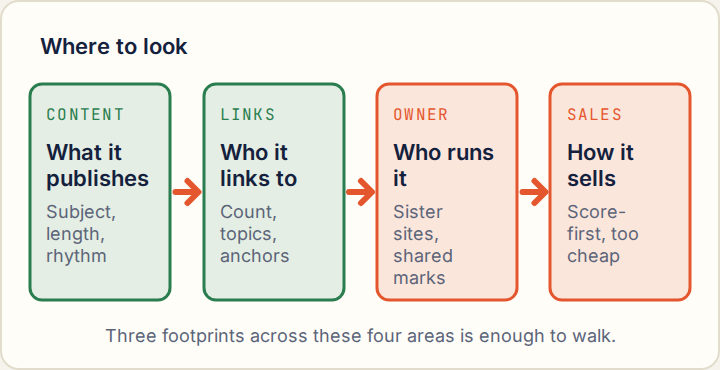
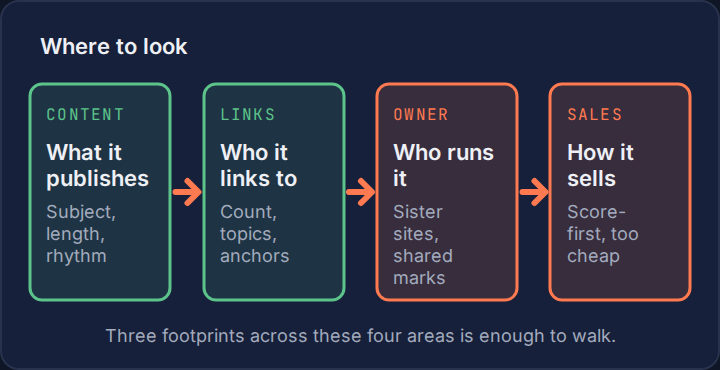
This checklist groups the footprints into four areas so you can work through a site in order and stop as soon as the count gets to three.
Link farm, PBN, or just a blog that sells posts
| Type | What it is | The tell |
|---|---|---|
| Blog that sells posts | A real site with readers that also takes paid articles. | Most posts are its own. Paid ones are a minority. |
| Link farm | A site whose business is selling links. Content exists to hold them. | Most posts carry a commercial link to an unrelated company. |
| PBN | Several link farms run by one owner and presented as separate sites. | Shared patterns across sites that claim no connection. |
The first kind is what you want. The checklist is for telling it apart from the other two.
Content footprints
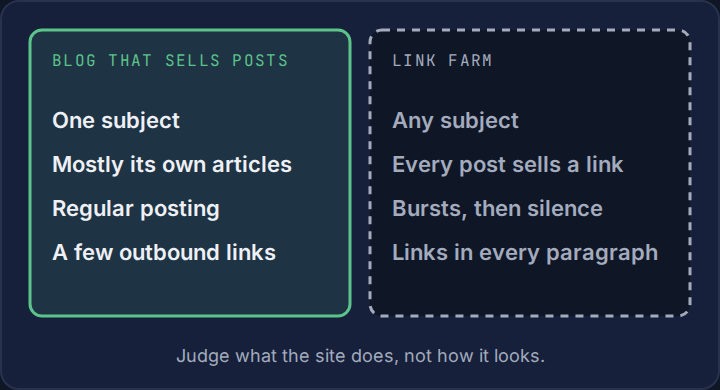
- 1. No subject. Roofing, crypto, pet food and dentistry on one blog. A site for everyone is a site for sellers.
- 2. Every post sells something. Each article has one link to a company, placed in the second or third paragraph.
- 3. Thin articles. Averages under 500 words, with nothing a reader would search for.
- 4. No pulse. Posts arrive in bursts with months of silence between, or stopped altogether.
Link footprints
- 5. Too many outbound links. More than 15 links to other sites per post. How to audit outbound links shows how to count.
- 6. Gray-topic links. Casino, CBD or crypto posts anywhere in the archive. Why that matters.
- 7. Exact-match anchors everywhere. Links read "best plumber in Leeds" where a writer would say the company's name.
Ownership footprints
- 8. A list of sister sites. The seller offers twenty more sites the moment you ask about one.
- 9. Shared fingerprints. The same theme, the same footer wording, the same contact form, or the same author names across those sites.
- 10. A recycled domain. An old name with a new, unrelated site on it. How to spot one.
Footprint 8 is not proof of a network on its own. Some people do run several real blogs. It becomes a footprint when the sites also share number 9.
Selling footprints
- 11. Score-first pricing. The price list leads with an authority score and says nothing about readers.
- 12. Too cheap for the score. A site claiming a very high score and selling permanent posts for a few dollars is selling the number.
How common these are
These are sites that looked like blogs at first glance. The dormant ones are the most likely to be bought and turned into link farms next.
How to use the count
| Footprints found | Decision |
|---|---|
| 0 or 1 | Carry on to the traffic checks. |
| 2 | Look harder. Ask the seller about the ones you found. |
| 3 or more | Walk away. |
| Number 6 on its own | Walk away. |
Three is our rule of thumb, not a law. It is set where a pattern stops being explainable by coincidence. The vetting checklist puts these checks alongside traffic and seller terms.
How to check this yourself
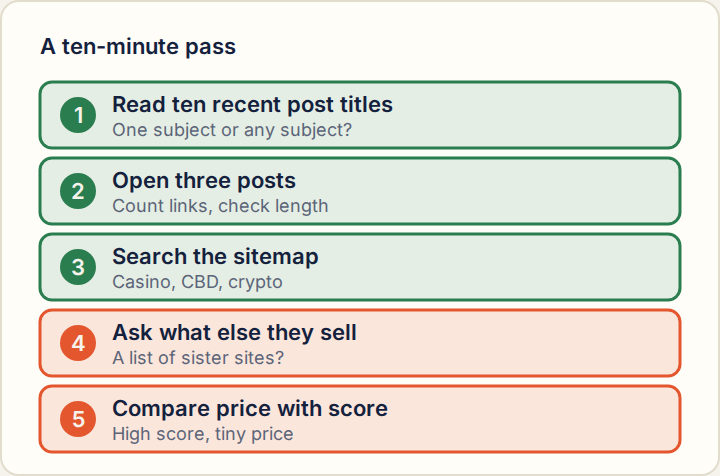
- Read the ten newest post titles. Count how many fit one subject.
- Open three posts from different months. Count the links to other sites and note the word count.
- Check the dates of the last twelve posts for bursts and gaps.
- Search the sitemap for casino, betting, cbd, crypto and loan.
- Ask the seller what other sites they have. If a list arrives, open three and compare themes, footers and authors.
- Put the price beside the claimed score. If it looks too good, treat it as footprint 12.
- Count the footprints. Three or more, or any gray-topic content, and you are done.
Questions buyers ask
- Are all sites that sell guest posts link farms?
- No. Plenty of real blogs take paid articles. The difference is proportion: a blog publishes mostly for its readers, and a farm publishes mostly for its buyers.
- Can Google tell a PBN from a real blog?
- Google says its systems detect link spam and can ignore or act on it, and its 2021 link spam update targeted sponsored and guest posts without proper link tags. How well it detects any one network is not public.
- Is a 'write for us' page a red flag?
- On its own, no. It becomes one when the page is a price list, is easier to find than the articles, or invites posts on any subject.
Related guides
Sources
- Google Search Central: spam policies for Google web search
- Google Search Central blog: link tagging and the link spam update (July 2021)
- BacklinkURLs methodology
Last updated Methodology