Buying and negotiating
Guest post terms to get in writing before you pay
Nobody signs a contract for a $100 guest post. The email thread is the contract. If the terms are not in it, they do not exist, and a year from now neither you nor the seller will remember what was said on a call.
This guide lists the eight terms, why each one matters, and a message you can copy.
Why writing matters
Ahrefs tracked links to more than two million sites and classified why links were lost. In 47.7% of cases the page or domain was dropped. In 34.2% the page was still there and the link had been removed.
You cannot do much about a site that closes. You can do something about an editor who removes your link, changes it to nofollow, or deletes the post during a tidy-up: you can have agreed beforehand that they will not, and have their reply to point to.
The eight terms
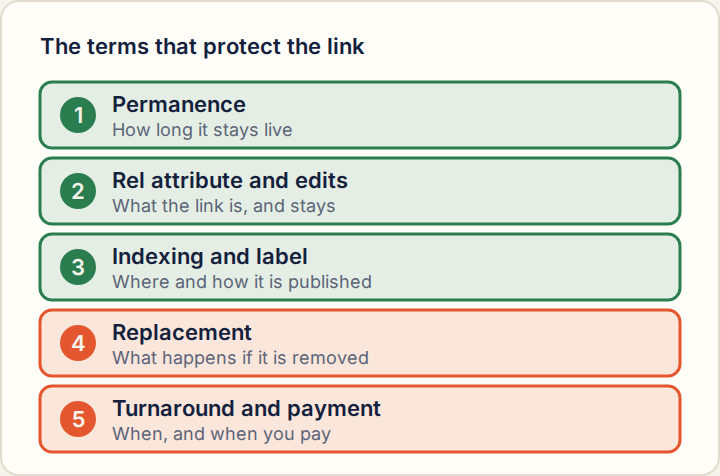
| Term | The question | A good answer |
|---|---|---|
| 1. Permanence | How long will the post stay live? | Permanently, or a stated period of at least 12 months. |
| 2. Edits | Will the link or anchor be changed later? | No changes without asking you first. |
| 3. Rel attribute | Will the link be plain, nofollow or sponsored? | A clear statement of which one. |
| 4. Indexing | Will the page be indexable? | Yes: no noindex tag, in a normal blog category. |
| 5. Label | Will the post be marked sponsored or guest? | A clear yes or no, and where the label appears. |
| 6. Replacement | What happens if the post or link is removed? | Reinstated, or replaced with an equivalent. |
| 7. Turnaround | How long from payment to publication? | A number of days. |
| 8. Payment | When and how do you pay? | On publication, or half before and half after. |
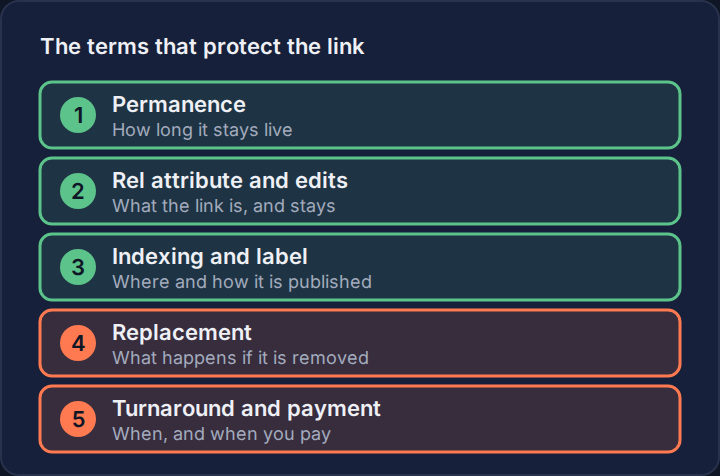
Term 3 is the one sellers are most often vague about. Ask it plainly. Google's spam policies treat links bought for ranking purposes as link spam unless they carry rel="sponsored" or rel="nofollow". Whatever the answer, you should know it before you pay, and it should match what the site's existing paid posts show. See how to check.
How sellers respond
What the words usually mean
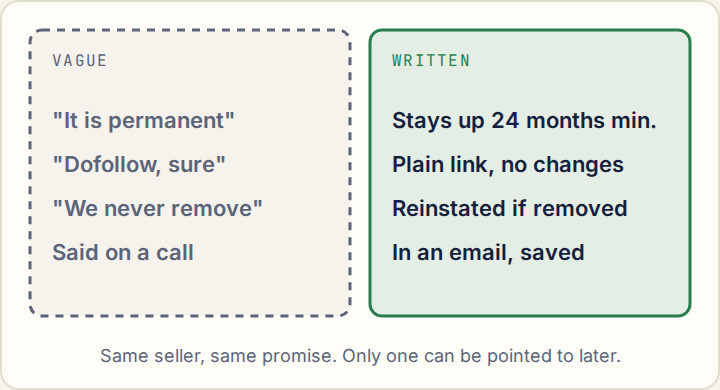
| They say | It can mean | Ask |
|---|---|---|
| "Permanent" | For as long as I own the site, and I feel like it. | Does that include if the site is sold or redesigned? |
| "Lifetime" | The same. | Is there a minimum period you guarantee? |
| "Dofollow" | No nofollow tag today. | Will it stay that way? |
| "No sponsored tag" | The post will not be labelled as paid. | Understood. Is the link tagged in the code? |
| "1 year" | The post is deleted or the link removed after 12 months unless you renew. | What does renewal cost? |
A message you can copy
"Thanks for the price. Before we go ahead, could you confirm a few things by reply:
- How long will the post stay live?
- Will the link be dofollow, nofollow or sponsored, and will that stay the same?
- Will the post be labelled as sponsored or a guest post?
- Will it be published in a normal blog category and be indexable?
- If the post or link is removed later, will you reinstate it?
- How many days from payment to publication, and do you take payment on publication?"
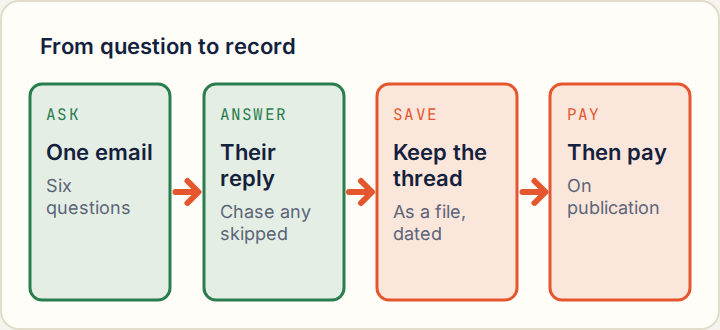
Six questions, one email. If the seller answers four and skips two, ask the two again. A skipped question is usually the one that matters.
After you have the answers
- Save the email as a file. Mailboxes get cleaned out.
- Record the terms beside the placement in your tracking sheet, with the date.
- Check them at day 1. The post-placement checklist compares what was promised with what was published.
- Use them if the link goes. What to do when a link is removed starts from this thread.
How to check this yourself
- Send the six questions in one email after you have the price.
- Chase any question that was skipped.
- Open two of the site's existing paid posts and check the rel attribute and label match what you were told.
- Agree payment on publication where the seller allows it.
- Save the thread as a file and note the terms in your tracking sheet.
- Set a reminder to re-check the link. A schedule is here.
Questions buyers ask
- Do I need a formal contract?
- For a single post, no. A clear email exchange is enough for both sides to know what was agreed. For large orders with one seller, a one-page written agreement is reasonable.
- Can I enforce these terms?
- In practice your leverage is the seller's reputation and future orders, not a court. That is why terms are worth agreeing before payment and why paying on publication helps.
- What if the seller says the link will be nofollow or sponsored?
- Then the site is tagging paid links the way Google asks. You are buying readers and exposure. Decide on that basis and price it accordingly.
Related guides
Sources
- Ahrefs: link rot study
- Google Search Central: spam policies for Google web search
- BacklinkURLs methodology
Last updated Methodology