Vetting a site before you pay
Outbound link audit: how many outbound links is too many?

Every guest post you buy sits on a page with other links, on a site that has sold other posts. How many, and to whom, decides what company your link keeps.
This guide gives you a counting method that takes ten minutes, thresholds to judge the result, and the reasons behind them.
Why the count matters
- It shows what the site is for. A blog links out when a source helps the reader. A link seller links out because someone paid.
- It shows your neighbours. If the post before yours links to a casino, yours shares a page list with it.
- It is hard to fake. A seller can dress up a homepage. They cannot easily hide what is in two years of posts.
Our inference
You will often read that a page's value is divided among its outbound links, so more links means less for each. That comes from the original PageRank idea. Google has not confirmed how it treats this today, so we use the count as a sign of what the site is, not as a formula.
How to count
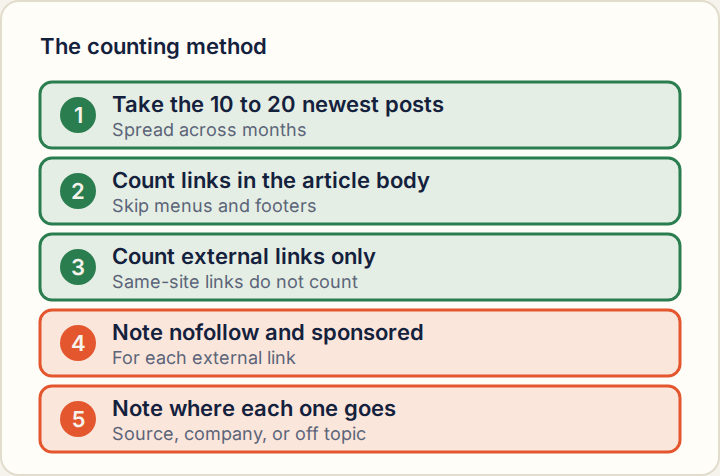
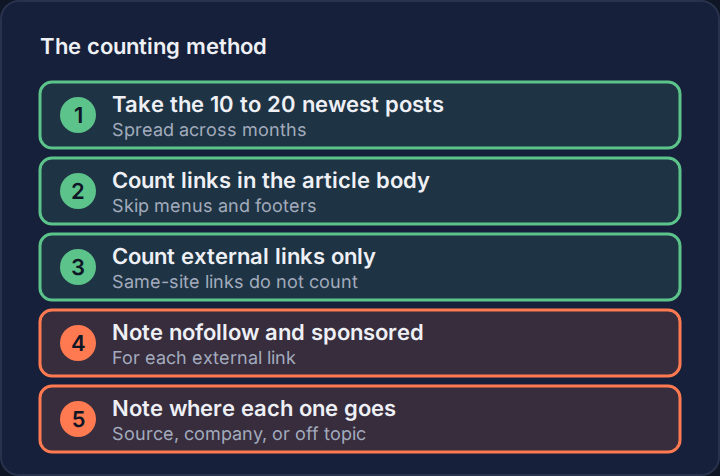
- Pick the posts. Take the ten newest, or better, the twenty newest. Include different months.
- Count body links only. Links inside the article text. Leave out navigation, sidebars, footers, related posts and author boxes.
- Count external links only. A link to another page on the same site does not count.
- Note the rel attribute. For each external link, note whether it is plain, nofollow or sponsored.
- Note where it goes. A source, a company, or a company on an unrelated subject.
Where to set your threshold
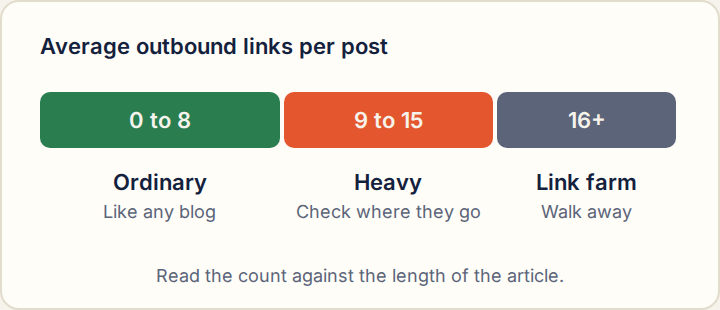
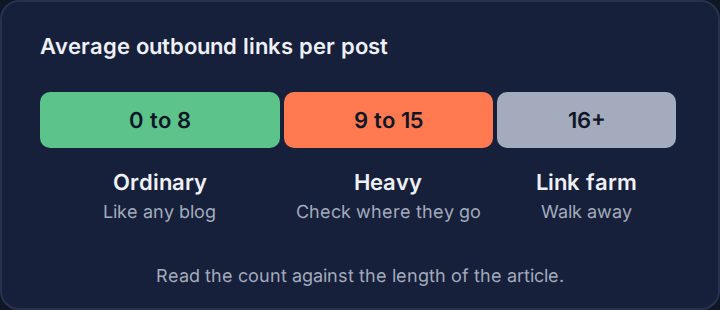
| Average per post | Reading | What to do |
|---|---|---|
| 0 to 8 | Ordinary blog. | Fine. Look at where they go. |
| 9 to 15 | Heavy. Could be a well-sourced site or a busy seller. | Check the destinations before deciding. |
| Over 15 | Link-farm territory. | Walk away. This is our fail line. |
The line at 15 is the threshold on our methodology page. The line at 8 is a rule of thumb. Length changes the picture: fifteen links in a 4,000-word reference piece is normal, and fifteen in 600 words is not, so read the count against the word count.
Where the links go matters more
| Links mostly go to | What it tells you |
|---|---|
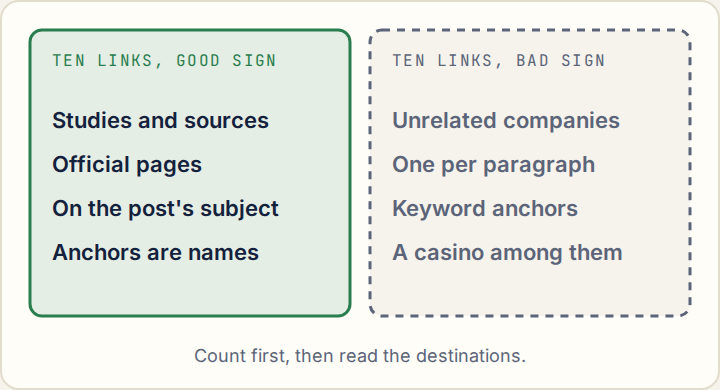
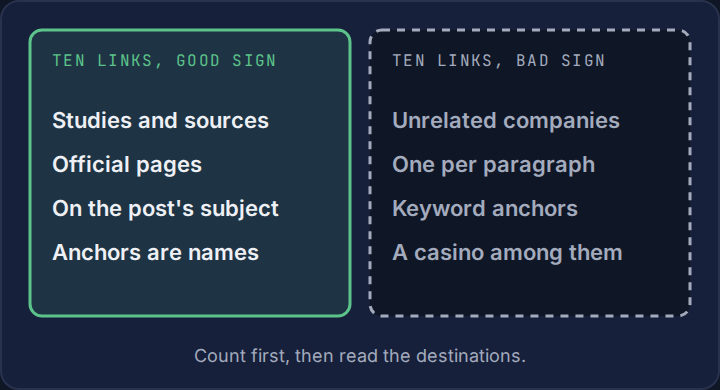
| Sources: studies, official pages, reference sites | The site writes for readers. |
| Companies on the site's own subject | It sells posts, in its own niche. Normal for a guest post site. |
| Companies on unrelated subjects | It sells to anyone. Expect your link to sit beside anything. |
| Casino, CBD, crypto or loans | Stop. See gray-topic contamination. |
Reading the nofollow share
Work out what share of the external links carry rel="nofollow" or rel="sponsored".
- Near zero. The site tags nothing. Paid links are presented as ordinary ones.
- A minority. It may tag paid links and leave source links plain, or the reverse. Open a known sponsored post and look.
- Most or all. The site tags everything. A link here is a labelled advertisement. It can still send readers, and it will not be treated as an editorial vote.
Confirmed by Google
Google's position is that paid links should carry rel="sponsored" or rel="nofollow", and that links bought for ranking purposes without them are link spam. A site that tags its paid links is doing what Google asks.
So the nofollow share is not good or bad in itself. It tells you what you are buying, and you should hear it from the page before you hear it from the seller. Get the rel attribute in writing either way.
What our data can and cannot say
How to check this yourself
- Open the blog index and list the ten newest posts.
- For each post, count the external links inside the article text.
- Add them up and divide by ten. Over 15, stop.
- Mark each link as source, on-topic company or off-topic company.
- View the page source on two posts and check which links carry rel="nofollow" or rel="sponsored".
- Find a post that is clearly paid and see how its link is tagged. That is how yours will be tagged.
Questions buyers ask
- Is there an official limit on outbound links?
- No. Google does not publish a number. The thresholds here are ours and exist to separate ordinary blogs from sites built to sell links.
- Do internal links count?
- No. Links to other pages on the same site are a good sign: they show the site connects its own content.
- Is a site with all nofollow links worth buying from?
- Only if you want readers and brand exposure from it. A nofollow or sponsored link is a labelled advertisement, which is what Google's policy asks paid links to be.
Related guides
Sources
- Google Search Central: spam policies for Google web search
- Google Search Central blog: link tagging and the link spam update (July 2021)
- BacklinkURLs methodology
Last updated Methodology