Buying and negotiating
Is buying backlinks against Google's rules? The policy, plainly

Anyone selling you links has a reason to be vague about this, and so does anyone selling you a list of link sellers. We sell such a list, so here is the position without softening.
This guide sets out what Google has published, what it has said it does about it, what is not known, and how to think about the risk you are taking.
What the policy says
Confirmed by Google
Google's spam policies define link spam as creating links mainly to manipulate search rankings. The first example given is buying or selling links for ranking purposes, which includes exchanging money for links or for posts that contain links, exchanging goods or services for links, and sending a product in return for a write-up with a link.
The same policy says that buying and selling links for advertising and sponsorship is a normal part of the web, and is not a violation as long as the link is qualified with rel="nofollow" or rel="sponsored".
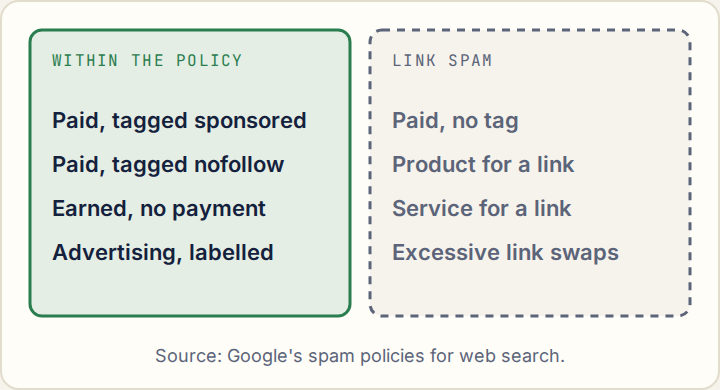
What the tags do
| Tag | Meaning | Use for |
|---|---|---|
| rel="sponsored" | This link was paid for. | Adverts, sponsorships, paid placements. |
| rel="nofollow" | The site does not vouch for this link. | Also accepted for paid links. |
| No tag | An ordinary editorial link. | Links nobody paid for. |
A tagged link can still send readers, put your brand in front of an audience, and be read by AI systems. What it is not meant to do is count as an editorial vote for ranking. If a seller offers a tagged link, you are buying advertising. Price it as advertising.
What Google says it does
Confirmed by Google
In its July 2021 post on link tagging, Google said that when it detects sites publishing or acquiring links through excessive sponsored and guest posting without proper link tags, algorithmic and manual actions may be applied. The same post said its systems had become much better at identifying link spam and at nullifying it.
- Ignored. Google's systems aim to discount links they judge to be spam. The link exists and counts for nothing.
- Algorithmic action. Automated systems can affect how a site ranks.
- Manual action. A human reviewer applies a penalty, which the site owner sees in Search Console and must fix and appeal.
Google does not publish how often each happens. Its emphasis on nullifying suggests being ignored is the common outcome, and that is our inference, not a statistic.
Confirmed by Google
Google ran spam updates in March, June and August 2026. The August update ran from August 18 to 21. Google announced no new spam policy types with it and did not say what it targeted.
Weighing your own risk
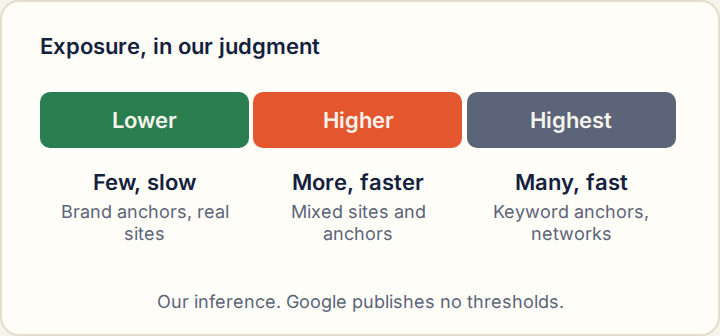
| Raises the risk | Lowers it |
|---|---|
| Many paid links placed in a short time | A few, spread over months |
| Exact keyword anchors | Brand names and plain descriptions |
| Sites that sell to anyone, on any topic | Real blogs on your own subject |
| Sites with gray-topic content | Sites with none |
| Paid links as most of your link profile | Paid links as a small share beside earned ones |
| Networks of related sites | Unconnected sites with their own readers |
Our inference
This table is our judgment, built from what the policy describes and from the patterns link spam systems are said to look for. Nobody outside Google can tell you where the lines are, and anyone who says a paid, untagged link is safe is guessing.
Your three honest options
| Option | What you get | What you accept |
|---|---|---|
| Buy tagged placements | Readers, brand exposure, mentions. Within the policy. | No intended ranking credit from the link. |
| Buy untagged placements | A link that may count, on a site you chose carefully. | It is against the policy. It may be ignored, and it carries some risk of action. |
| Do not buy | No policy risk from links. | Slower. Links come from outreach, PR and content. |
We are not going to tell you which to choose. Businesses pick all three, and many mix them. What we will say is that the second option done carelessly is the worst of all: money spent on links that are ignored, on sites that put your name beside a casino.
Where vetting fits
Those figures describe waste and bad company, which vetting removes. They say nothing about policy, which vetting cannot change. The vetting checklist is for the first problem only.
How to check this yourself
- Read the policy yourself. It is short, and the link section is a few paragraphs.
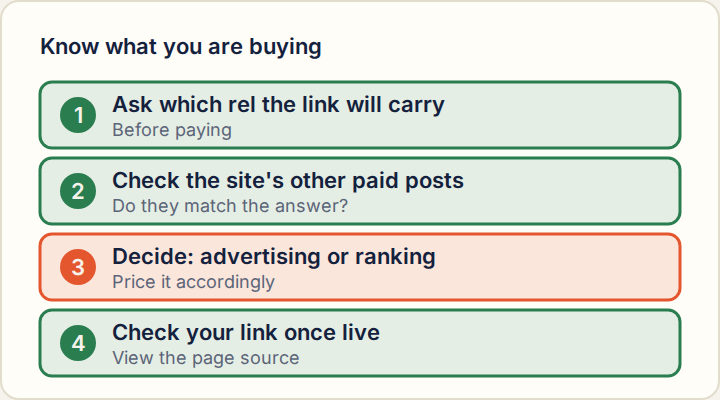
- Ask every seller which rel attribute the link will carry.
- View the source of an existing paid post on the site and look at the link's rel value.
- Decide which of the three options you are taking for this placement.
- Look at your own link profile. What share is paid, and how fast is it growing?
- Keep anchors plain. Brand names and descriptions.
Questions buyers ask
- Will I get a penalty for buying one guest post?
- Nobody outside Google can say. Its stated approach is mainly to ignore links it judges to be spam, and its warnings mention excessive sponsored and guest posting. One untagged paid link is still against the policy.
- Is a sponsored or nofollow link worthless?
- Not if the site has readers. It can send visitors and put your brand in front of an audience. It is not meant to pass ranking credit, so pay what the audience is worth.
- Do site owners get penalised too?
- Google's 2021 statement covers sites that publish such links as well as sites that acquire them.
- Does BacklinkURLs sell Google-approved links?
- No. We sell information: which sites sell placements, what they charge, and what our checks found. Whether a link is tagged is between you and the seller, and each seller's own answer on link type is shown on the listing.
Related guides
Sources
- Google Search Central: spam policies for Google web search
- Google Search Central blog: link tagging and the link spam update (July 2021)
- Search Engine Journal: Google finishes rolling out the August 2026 spam update
- BacklinkURLs methodology
Last updated Methodology