How links work
Do backlink clicks matter for SEO?

The idea is attractive: if real people click a link, Google must see that and reward it. It may even be true. But it has not been confirmed, and a lot of money is spent on click services by people who think it has.
This guide sets out exactly how far the evidence goes, then covers the part that is certain: how to get links that readers use.
How far the evidence goes
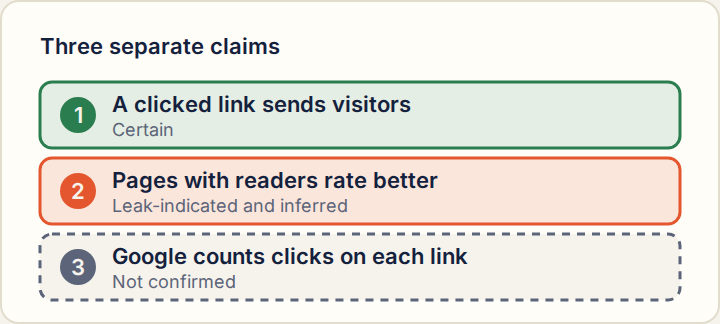
Confirmed by Google
Google has said links are one of many signals and that it works to ignore links placed to manipulate rankings. It has also said, through John Mueller, that a link's value can fall as its page becomes less relevant or moves into an archive. Google has not said that it measures clicks on individual links to decide their value.
Indicated by the 2024 documentation leak
Google documentation that became public in 2024 records the index tier of a link's source page. Analysts who studied it also suggest that Google's site-level quality signals may draw on click data, though they present this as their own view. Nothing they reported shows clicks on a particular link being counted toward that link.
Our inference
The reasonable chain is indirect. Pages with readers are more likely to be pages Google rates. Links on pages Google rates are more likely to count. A link that gets clicked is, at the least, a sign it sits on such a page. We act on that chain by checking traffic. We do not claim the click itself is measured.
The part that needs no theory
- Clicks are visitors. A link that sends 30 readers a month is worth having whether or not it moves a ranking.
- Clicks are evidence. If your analytics show visits from the host site, the page is alive and your link is visible.
- No clicks is a warning. A link that has sent nobody in six months sits on a page nobody reads.
So you can treat clicks as the goal in themselves and let the ranking question look after itself.
What makes a link get clicked
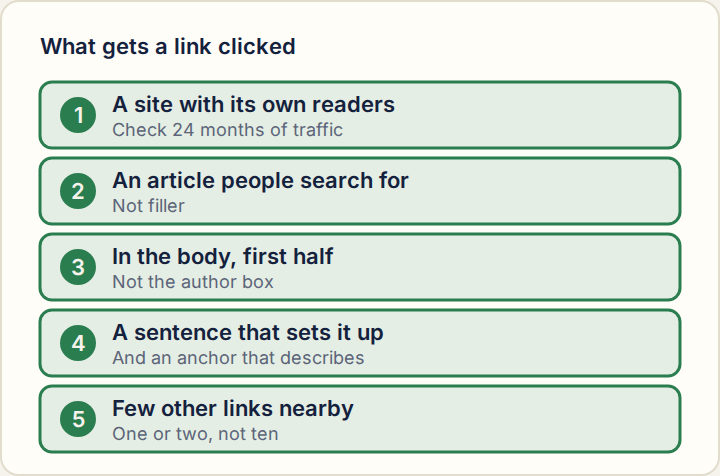
| Factor | Clicked | Ignored |
|---|---|---|
| The site | Has its own readers | Exists to hold links |
| The article | Answers a question people search for | Generic filler |
| Position | In the body, first half | Author box, footer, last line |
| The sentence | Sets up why the link helps | Link dropped in with no lead-in |
| The anchor | Says what is behind it | "Click here" or a bare keyword |
| Company | One or two links nearby | Ten links in the paragraph |
How to write a guest post readers click and anchor text and context go through the last four rows.
How to see whether your link is clicked
- Referral visits. In your analytics, look for sessions arriving from the host site's domain.
- A tagged link. If the seller allows it, add tracking parameters so the placement is named in your reports.
- A dedicated landing page. Visits to it can only have come from that placement.
- Give it time. Count over three months, not three days.
Why fake clicks are a mistake
Confirmed by Google
Google's spam policies list machine-generated traffic. Services that sell clicks or run bots to visit pages fall under it.
- They cannot produce the thing you want, which is readers.
- They leave patterns: no time on page, no second visit, odd locations.
- They add risk to a placement that had none on that count.
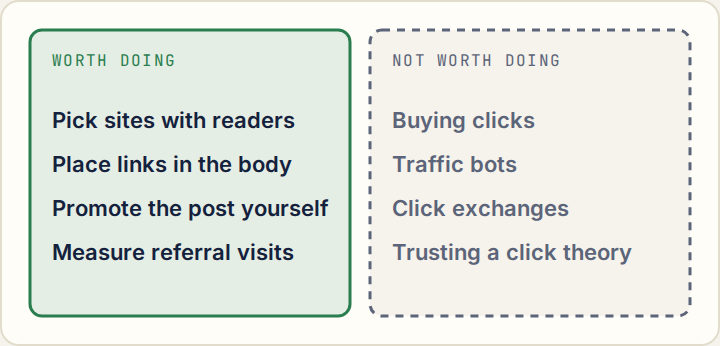
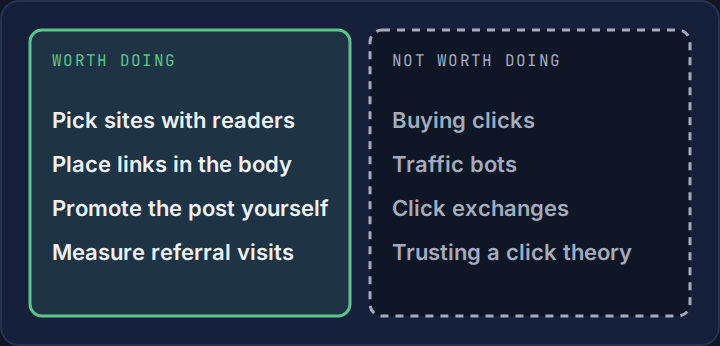
If you want more clicks, send real readers to the post from your own newsletter and social accounts.
What our data shows about readers
Split 500 visits across hundreds of posts and most pages see nobody in a month. No placement, anchor or sentence can make a link clicked on a page with no readers.
How to check this yourself
- Open your analytics and list referral visits by source domain for the last three months.
- Match them to your placements. Which paid links sent anyone?
- For the ones that sent nobody, open the page and check where the link sits.
- Check the host site's traffic. Under 500 visits a month explains it.
- For new orders, ask for a body placement in the first half and write the sentence yourself.
- Promote each new post in its first two weeks.
Questions buyers ask
- Does Google use click data for ranking?
- Google has not published how it uses click data. Analysts read the 2024 leak as suggesting some user signals exist. Nothing confirms that clicks on a specific link raise that link's value.
- Is a link with no clicks worthless?
- Not necessarily. It may still be on an indexed, relevant page. But it is a sign the page has few readers, and you are getting no visitors from it.
- Should I buy traffic to my backlinks?
- No. Bought clicks are machine-generated or paid visits, which Google's spam policies name, and they do not produce readers.
Related guides
Sources
- Search Engine Land: links and digital PR takeaways from the Google documentation leak
- Search Engine Journal: Google on whether link value changes with age
- Google Search Central: spam policies for Google web search
- BacklinkURLs methodology
Last updated Methodology