How links work
Do backlinks lose value over time? Link decay, explained

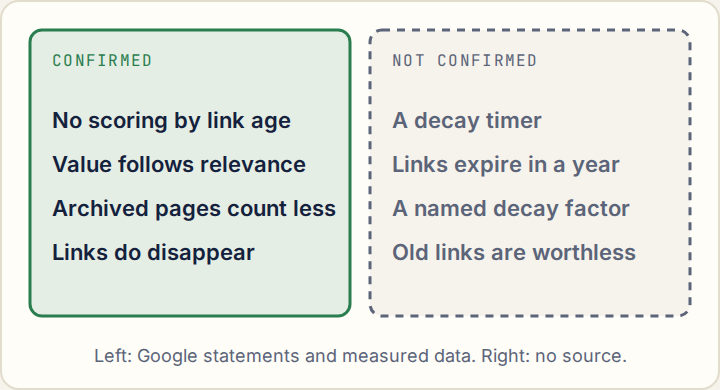
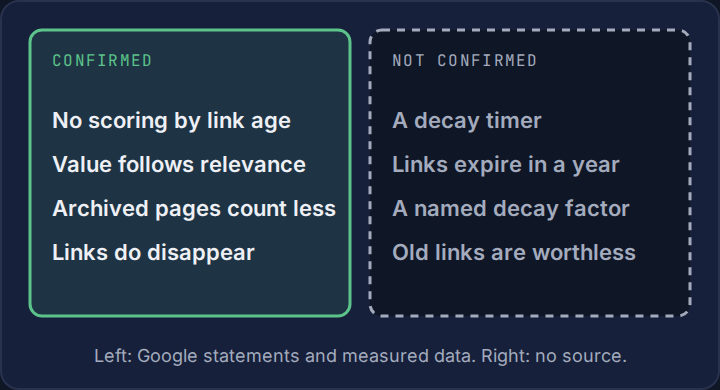
You will read that links "decay", as if each one carried a clock. It is a useful picture and a misleading one. Nothing published by Google says age itself reduces a link's value.
What does happen is plainer. Pages sink, sites drift, editors prune, and domains die. This guide separates the layers so you know which parts are fact.
Three layers of evidence
Confirmed by Google
In a 2020 Google hangout, John Mueller was asked whether link value falls with age. As reported by Search Engine Journal, he said Google does not track how old a link is and assign value on that basis. He added that value can change as sites evolve: a link in a news article may matter a great deal while the article is near the front of the site, and less once it has moved to an archive.
Indicated by the 2024 documentation leak
Google documentation that became public in 2024 describes a link attribute, sourceType, tied to the index tier of the source page. Analysts report that newly published pages are handled as a special case and treated like high-quality sources. That would give a link an early period of extra weight which later settles. The leak does not say how this is weighted or whether it is in use.
Our inference
Put together, the likeliest picture is that a link's value follows the fortunes of its page. It is strongest while the page is fresh and prominent, and it falls if the page is buried, the site loses its readers, or the content stops matching your subject. That is our reading, and it involves no age counter.
Link rot is a different thing, and it is measured
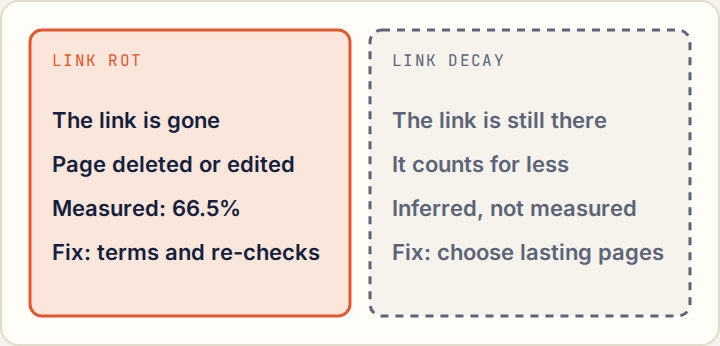
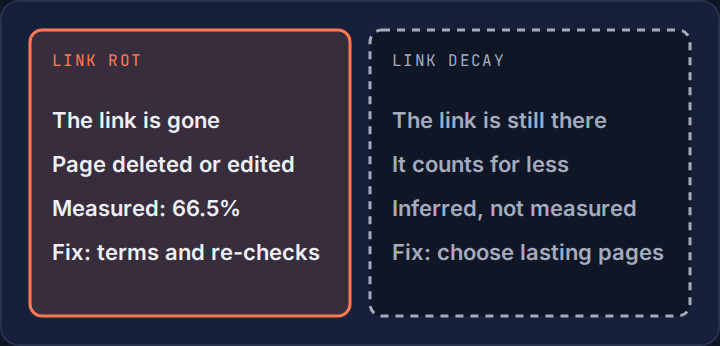
Decay is about a link counting for less. Rot is about the link no longer being there. The second has hard numbers.
- Rotted since January 2013
- 66.5%
- Lost for ranking purposes, all causes
- 74.5%
Of the links Ahrefs counted as lost, 47.7% went because the page or domain was dropped, and 34.2% because the link was removed while the page stayed live.
How a link loses value in practice
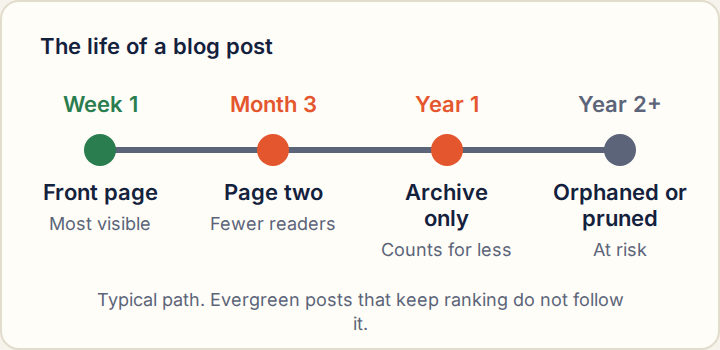
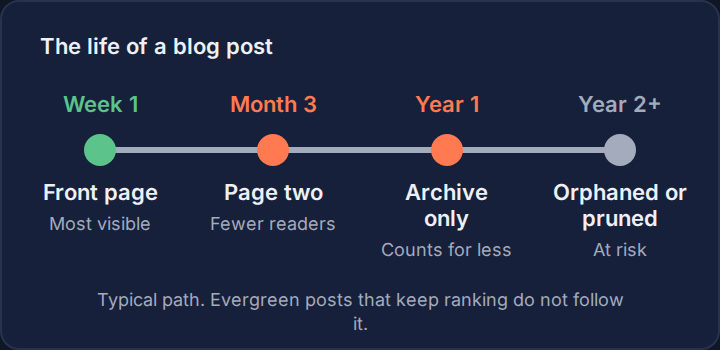
| Stage | What happens to the page | What it means for the link |
|---|---|---|
| Week 1 | On the homepage and the blog's first page. | As visible as it will ever be. |
| Month 3 | Pushed to page two or three of the blog. | Fewer readers, crawled less often. |
| Year 1 | Reachable only through category archives. | Counts for less, by Mueller's example. |
| Year 2 and later | Orphaned, pruned, or the site changes hands. | At risk of removal or of the page being dropped. |
What is myth
- "Links expire after a year." No source. Mueller said the opposite about age.
- "Old links are worthless." A link on an evergreen page that still ranks and still gets read can hold its value for years.
- "You need constant new links to replace decayed ones." You need to replace lost ones. Check which you have lost before buying more.
- "Google has a link decay factor." Nothing confirmed and nothing by that name in what analysts reported from the leak.
What our data adds
A link on one of those sites has, in effect, decayed with it. The page is still there. The readers are not.
What to do about it
- Buy pages that stay visible. Evergreen subjects on sites that link to their own older posts.
- Buy sites that are holding their traffic. How to read the history.
- Get permanence in writing. What to ask.
- Re-check on a schedule. 30, 90, 180 and 365 days.
- Keep the post alive. Send it readers and link to it from your own site.
How to check this yourself
- List your existing paid links with the date each went live.
- Open each page. Is it live, and is your link still there?
- Search Google for each address. Is the page still indexed?
- Click from the site's homepage toward the post. Can you still reach it?
- Pull the site's traffic history. Has the site held its readers since you bought?
- Mark each link as working, weakened or lost, and total what each group cost.
Questions buyers ask
- How long does a backlink last?
- There is no fixed life. Ahrefs found about two thirds of links to its sample had rotted since 2013. A link on an evergreen page of a stable site can last many years.
- Do older backlinks have less value than new ones?
- Google's John Mueller said Google does not assign value by a link's age. Value can fall if the page becomes less relevant or less prominent, and it can hold if the page stays useful.
- Should I keep building links to replace decayed ones?
- First find out which links you have lost. Replacing a removed link by asking the seller to reinstate it is cheaper than buying a new one.
Related guides
Sources
- Search Engine Journal: Google on whether link value changes with age
- Search Engine Land: links and digital PR takeaways from the Google documentation leak
- Ahrefs: link rot study
- BacklinkURLs methodology
Last updated Methodology