Buying and negotiating
How to write a guest post that readers actually click

Most guest posts are written for a search engine that is not reading them. They are 600 words wrapped around a link, and the host's readers scroll past.
A post written for the people who visit the site does better on every count. It gets read, it stays near the front of the site for longer, the link gets clicked, and the site owner is less likely to delete it in a clear-out.
Why readers come first
Confirmed by Google
Google's John Mueller has said the value of a link can fall as the content around it becomes less relevant, with the example of an article that moves from near the homepage into an archive.
Confirmed by Google
Google's link best practices page says the words before and after links matter, and tells writers to pay attention to the sentence as a whole.
Indicated by the 2024 documentation leak
Google documentation that became public in 2024 lists attributes for the text around a link, not only its anchor. Analysts read this as the surrounding words helping to describe what the link is about. How much weight it carries is not known.
Our inference
A post that readers find, read and share stays visible on the site for longer. We think that makes the link in it more durable. Whether clicks themselves matter is a separate question.
Before you write: read the host
- Read its five most popular posts. Note the length, the tone, and whether they use lists, steps or stories.
- Find the gap. A question its readers would ask that the site has not answered.
- Check what it links to. If its posts link out to sources, yours should too.
- Ask for the guidelines. Word count, image rules, how many links, and whether the brand may be named.
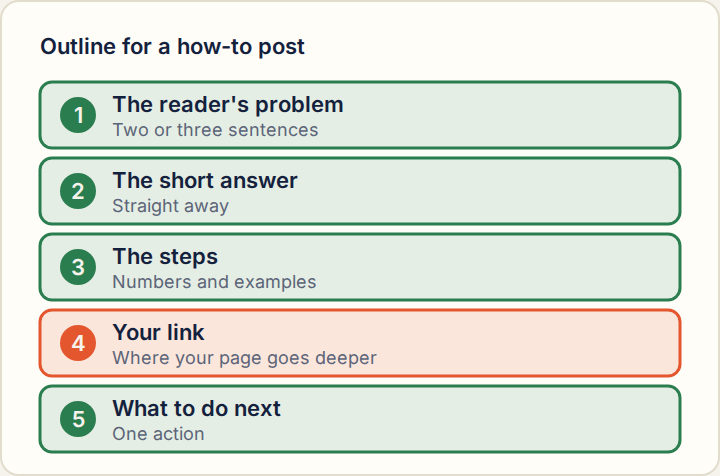
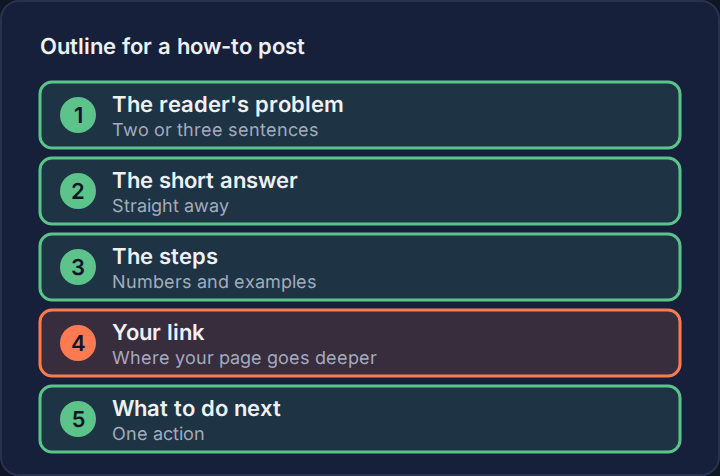
A structure that works
| Part | What goes in it | Common mistake |
|---|---|---|
| Opening | The reader's problem in two or three sentences. | A paragraph about how important the topic is. |
| The answer | The short version, straight away. | Saving it for the end. |
| The how | Steps, numbers, examples from real work. | General advice anyone could write. |
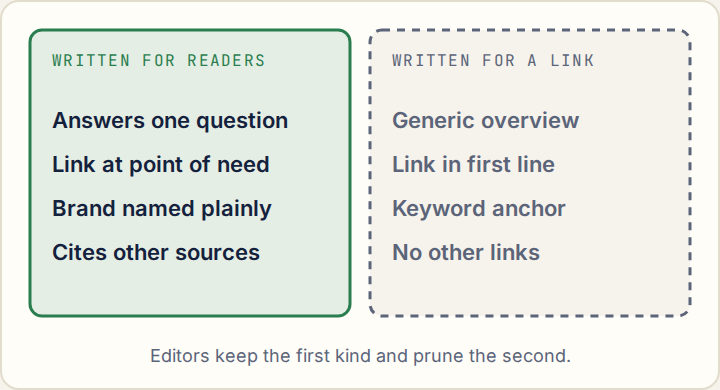
| The link | At the step where your page goes deeper. | In the first line, or in an author box nobody reads. |
| The close | What to do next. | A summary of what was just said. |
Where the link goes
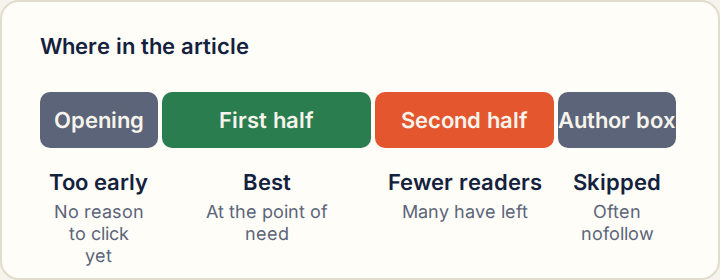
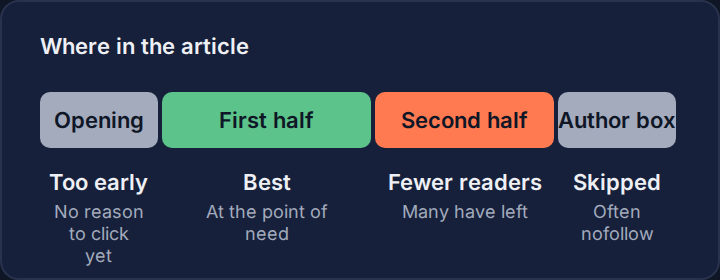
- In the body, not the bio. Author boxes are skipped by readers and often tagged nofollow.
- In the first half. Many readers do not reach the end.
- At a point of need. Right after you raise a question your page answers.
- Once. One well-placed link beats three scattered ones, and most hosts allow one or two.
- With sources beside it. A post that also links to a study or an official page reads as an article. A post with one commercial link reads as an advert.
The anchor and the words around it
| Anchor | Reads as | Use it |
|---|---|---|
| Your brand name | A natural reference. | Often. It is how real writers link. |
| A description of the page | "this guide to insulating a loft" | Often. The reader knows what they will get. |
| An exact keyword | "best loft insulation company" | Rarely. It reads as paid, to people and to Google. |
| "Click here" | Nothing. | Never. |
The sentence carries as much as the anchor. Write one that would still make sense with the link removed. Anchor text and context has worked examples.
Get the brand named
Ahrefs studied 75,000 brands and found that mentions of a brand across the web correlated with appearing in Google's AI Overviews at 0.664, against 0.218 for the number of backlinks. That is a correlation, not proof of cause, but it points one way: being named matters.
So ask the host whether the brand may appear in the text, and write a sentence a reader would accept:
- Weak: "For more information, visit this website."
- Better: "Acme Lofts, an insulation installer in Leeds, publishes its measured heat-loss figures for each job."
The second names the brand, says what it is and where, and gives the reader a reason to care. Links versus mentions in AI search explains the reasoning.
Before you send it
- Would the host's editor have published this with no payment?
- Does it answer one question fully?
- Is the link at the point a reader would want it?
- Is the brand named in a plain sentence?
- Does it link to at least one source that is not you?
- Is it as long as the host's better posts?
How to check this yourself
- Read the host's five most popular posts and note length, tone and format.
- Pick one question its readers have that the site has not answered.
- Outline it as problem, answer, steps, next action.
- Decide where your page helps and place the link there.
- Write the brand sentence and check it would read fine with the link removed.
- Add one or two source links to studies or official pages.
- Compare it with the host's best post. If yours is weaker, keep going.
Questions buyers ask
- How long should a guest post be?
- As long as the host's better posts on similar subjects. Our own checks treat an average under 500 words as thin.
- How many links can I include?
- Follow the host's rule, which is usually one or two. One link in the right place does more than several.
- Should the anchor text be my keyword?
- Rarely. Brand names and plain descriptions are how writers link when nobody is paying, and they give readers a reason to click.
Related guides
Sources
- Ahrefs: AI Overview brand correlation study (May 2025)
- Search Engine Journal: Google on whether link value changes with age
- Google Search Central: link best practices
- Search Engine Land: links and digital PR takeaways from the Google documentation leak
Last updated Methodology