For agencies
How to report backlink quality to clients without leaning on DR

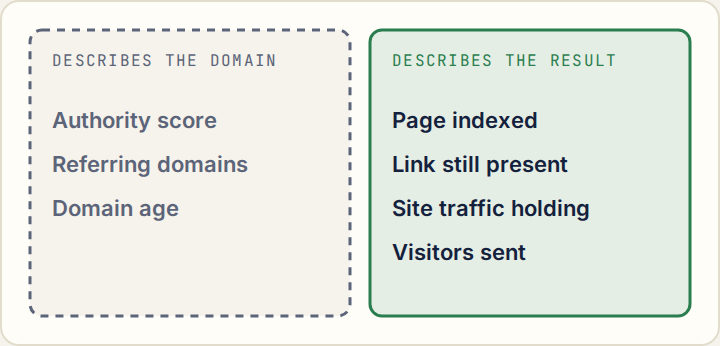
Most link reports are a table of addresses with a DR column, sorted so the biggest numbers are on top. Clients have learned to read it as a score: more rows, higher numbers, good month.
It is the wrong lesson, and it leaves the agency exposed when a high-DR site turns out to have no readers. This guide gives you a report built on things a client can verify.
What the DR report hides
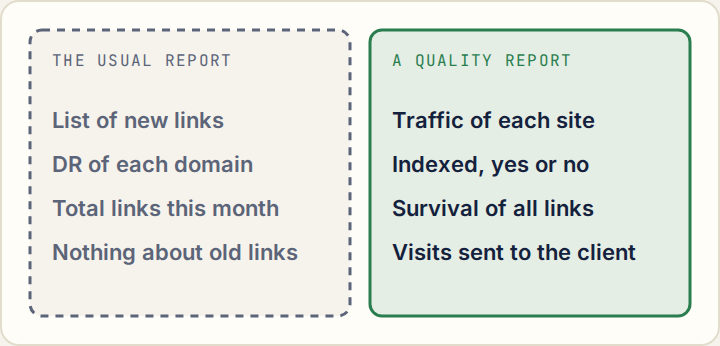
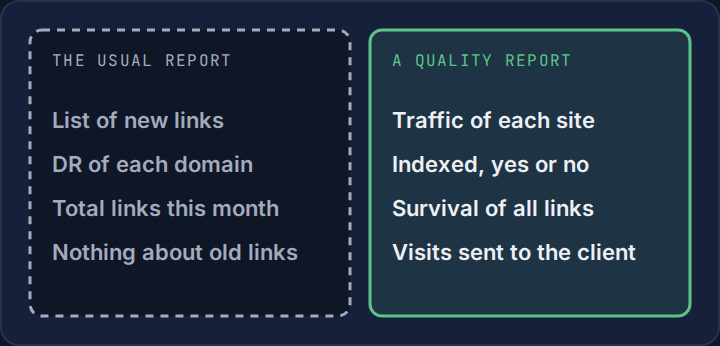
- Whether the page is indexed. A link Google has not indexed does nothing.
- Whether the site has readers. A score can outlive its traffic by years.
- Whether the link is still there. Last quarter's placements are assumed to exist.
- Whether anyone clicked.
What to report instead
| Measure | What it tells the client | Where it comes from |
|---|---|---|
| Linking site's traffic | Does the site have readers? | Latest 3-month average of estimated visits. |
| Traffic against peak | Is the site holding or fading? | Latest 3 months as a share of the best 3 in 24. |
| 3-month change | Which way is it heading? | Latest 3 months against the 3 before. |
| Page indexed | Can Google see the link? | Search for the exact address. |
| Link present, rel unchanged | Is what we bought still there? | Open the page and view the source. |
| Referral visits | Did anyone come through it? | The client's analytics. |
| Cost per 1,000 visitors | Was the price fair? | Price divided by monthly visits, times 1,000. |
How to read traffic history explains the three traffic rows in terms you can reuse for clients.
Lead with a survival rate
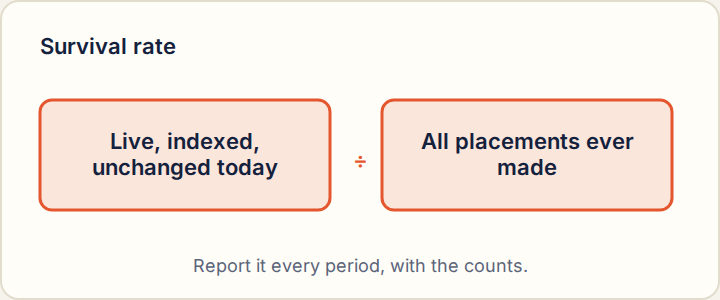
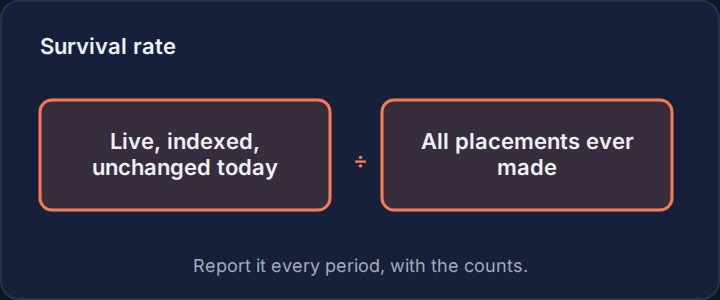
Survival rate = placements live, indexed and unchanged today ÷ all placements ever made for this client.
Report it every period, with the count. It rewards choosing sites that last, and it tells the client something DR never did: how much of what they paid for still exists.
| This period | All time | |
|---|---|---|
| Placements made | 6 | 48 |
| Live and indexed today | 6 | 41 |
| Link removed or changed | 0 | 4 |
| Page gone | 0 | 3 |
| Survival rate | 100% | 85% |
A report layout
- Page 1: the summary. Placements made, survival rate, referral visits, anything lost and what was done about it.
- Page 2: this period's placements. One row each with the measures above.
- Page 3: status of all earlier placements. Working, weakened or lost.
- Page 4: what the measures mean. Five lines, written once.
- Appendix: method. How sites are chosen and re-checked. See a QA process for agencies.
The template below has the columns for pages 2 and 3.
Reporting a loss
| Say | Not |
|---|---|
| "The link on example.com was removed in October. We asked for it to be reinstated on the 4th and it was restored on the 9th." | (nothing) |
| "Two sites from 2025 have lost most of their traffic. The links are live. We count them as weakened." | "All links active." |
| "This site passed our checks in March and has since added casino content. We have asked for removal of the post." | (nothing, until the client finds it) |
What to do when a link is removed has the steps behind the first row.
Be straight about policy
Confirmed by Google
Google's spam policies treat links bought for ranking purposes as link spam unless they carry rel="sponsored" or rel="nofollow".
A client paying for placements should know which of their links are tagged and which are not, and what that means. Put the rel attribute in the table and a two-line explanation on page 4. The policy guide has wording you can adapt.
If the client insists on DR
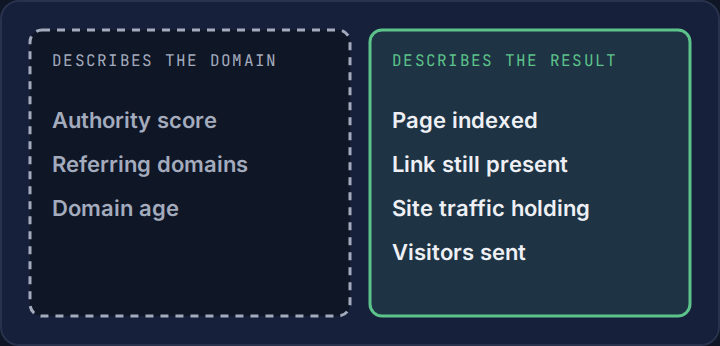
Some will, because every other agency reports it. Add it as the last column and never sort by it. Beside it, show traffic against peak. The first time a client sees a high score next to "22% of peak", the conversation changes.
How to check this yourself
- List every placement ever made for one client.
- Check each one: live, indexed, link present, rel unchanged.
- Pull traffic for each linking site and work out its share of peak.
- Pull referral visits from the client's analytics by source domain.
- Work out the survival rate.
- Write the summary first, including anything lost.
- Add five lines explaining the measures, and reuse them every period.
Download the report template (CSV)
Questions buyers ask
- What should a backlink report include?
- For each placement: the page address, the linking site's traffic and trend, whether the page is indexed, whether the link is present and unchanged, and visits sent. Plus a survival rate across all placements.
- Should I stop reporting DR?
- You can keep it as a column if clients expect it. Stop leading with it and stop sorting by it, because it does not show whether a link is working.
- How often should link reports go out?
- Monthly suits most retainers. Re-check older placements at least quarterly so the survival rate is current.
Related guides
Sources
Last updated Methodology