Vetting a site before you pay
Gray-topic contamination: why casino, CBD and crypto links taint a site

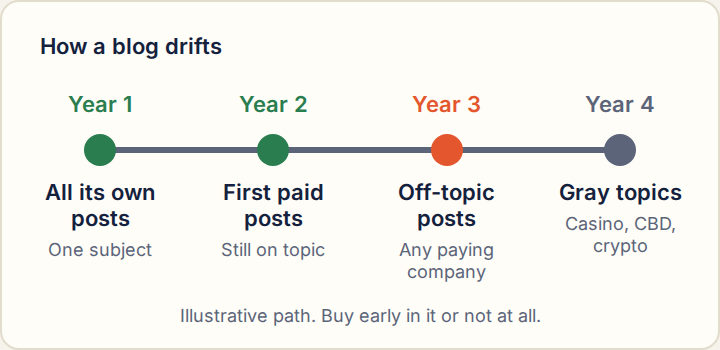
You find a home improvement blog with decent traffic and a fair price. The homepage is all kitchens and gardens. Three clicks into the archive there is a post about online slots.
That post tells you who else the site sells to, and what your client's link will be sitting beside. This guide shows how to find such posts in a few minutes and how often they turn up.
Why one casino post matters
- It shows the site's standards. A gardening blog has no editorial reason to cover online betting. The post is there because someone paid.
- It decides your neighbours. Your link shares a site, a category page and often a "recent posts" list with those articles.
- It is what your client will see. Clients click through. A plumber does not want to find their name two posts away from a CBD shop.
- It predicts what comes next. A site that takes this money today will take more of it tomorrow, and the share only grows.
Confirmed by Google
Google's spam policies name link schemes and, separately, site reputation abuse. One of its published examples is a medical site hosting a third-party page about the best casinos. Google has not said that a single gray-topic post lowers the value of other links on the site.
Our inference
We treat gray-topic content as a sign of a site selling to all comers, which is the pattern Google's link spam systems are built to find. That is our reading of the risk, and it is the reason for our knockout rule. It is not a statement of how Google scores any one site.
Where the posts are hidden
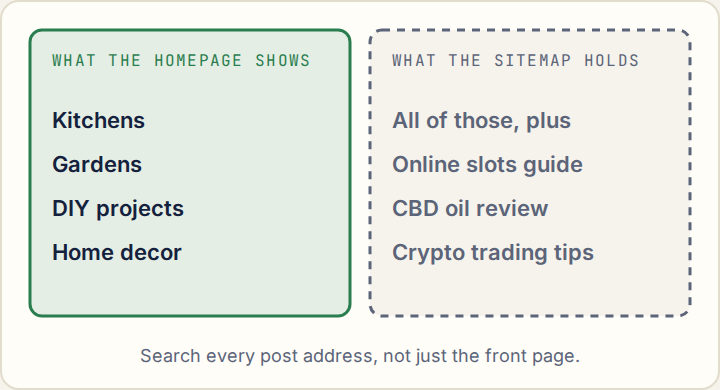
- Not on the homepage. Sellers set these posts to skip the front page and the main categories.
- In their own category. Often something bland like "general", "lifestyle" or "business".
- In old posts. A link gets inserted into an article from years ago that nobody rereads.
- In the address, not the title. The headline is mild and the page address contains the keyword the buyer wanted.
How to search a site yourself
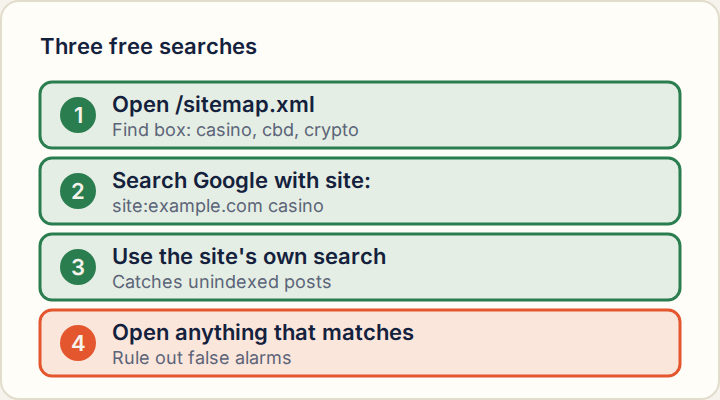
1. The sitemap. Add /sitemap.xml to the domain. Open the post sitemap and use your browser's find box on each word in the list below. This is the most thorough check because it covers every post address the site has.
2. A site search in Google. Search for the domain with a site: prefix followed by a word, for example site:example.com casino. This looks inside the text of pages Google has indexed.
3. The site's own search box. Slower, but it finds posts Google has not indexed.
| Topic | Words to search |
|---|---|
| Casino and betting | casino, betting, gambling, poker, slots, sportsbook, bingo |
| CBD and cannabis | cbd, cannabis, marijuana, thc, kratom, hemp |
| Crypto and forex | crypto, bitcoin, forex, trading |
| Loans | payday, loan |
| Vaping | vape, vaping |
| Adult | adult, escort, dating |
| Essay writing | essay, assignment, dissertation |
Expect some false alarms. "Poker" matches a fireplace poker and "loan" matches a home loan guide, which is a fair subject for a property blog. Open the post before you decide.
How common it is
So the sitemap check earns its place: without it, a fifth of these sites would have passed. And one post is common enough that "it is only one" is the usual state of a site at the start of the slide.
What to do when you find one
| What you found | Decision |
|---|---|
| Nothing after all three searches | Pass. Carry on with the other checks. |
| A false alarm (fireplace poker, home loan guide) | Pass. |
| One real gray-topic post | Walk away. This is our knockout line. |
| The seller offers to remove it | Still walk. The willingness to publish it has not changed. |
How to check this yourself
- Open the sitemap at /sitemap.xml and go to the post sitemap.
- Search each word in the table with the browser's find box.
- Run site: searches in Google for casino, cbd, crypto and betting.
- Try two or three words in the site's own search box.
- Open every match and decide whether it is real or a false alarm.
- One real match, stop. Do not negotiate it away.
Questions buyers ask
- Is CBD or crypto content illegal or banned by Google?
- No. These are lawful subjects in many places and Google indexes sites about them. The issue is a home or lifestyle blog publishing them for payment, which shows it sells to anyone.
- What if my own business is in one of these niches?
- Then you want sites that cover your subject properly, and this check is reversed: avoid general blogs that take your topic only for money, for the same reason.
- The seller says the casino post was a one-off. Does that change things?
- Not for us. One post is how every such archive starts, and our scan found a single matching post on more than a quarter of flagged sites.
Related guides
Sources
Last updated Methodology