Vetting a site before you pay
Guest post vetting checklist: a scorecard with pass and fail lines

Most guest post checklists are lists of things to "consider". This one has lines. Each check says what to look at, where the pass line sits, and what a fail costs you, so two people scoring the same site get the same answer.
The lines are the ones we use on our own lists, plus a few rules of thumb where we say so. You can print this page, or download the scorecard as a spreadsheet file at the end.
How the scorecard works
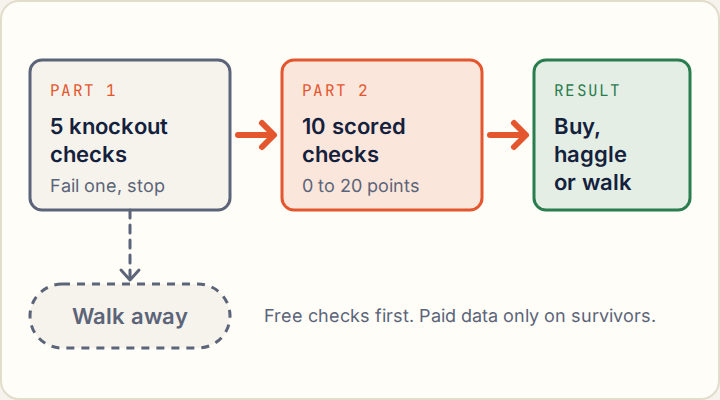
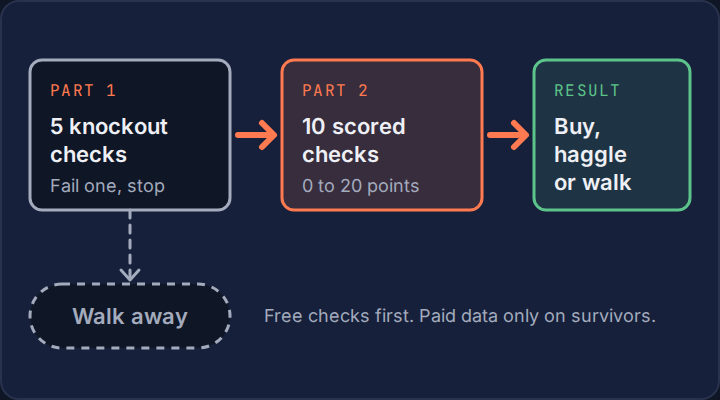
Part 1 is five checks that end the review on the spot. Do them first, in the order shown, because the early ones are free and take minutes.
Part 2 is ten checks scored 0, 1 or 2. They separate a good site from one that merely survived Part 1. Add them up for a score out of 20.
Part 1: the five knockout checks
Fail any one of these and stop. No score in Part 2 makes up for it.
| Check | How to check it | Knockout when |
|---|---|---|
| 1. Loads on its own domain | Open the homepage and watch the address bar. | It errors, or redirects to a different domain. |
| 2. No gray topics | Open the sitemap and search post addresses for casino, betting, CBD, crypto, vaping, payday loans, adult and essay writing. Then search the site itself for the same words. | Any of them turns up. |
| 3. Enough search traffic | Take the latest 3-month average of estimated Google visits and of ranking keywords. | Under 500 visits a month, or under 100 keywords. |
| 4. No traffic collapse | Divide the latest 3 months by the best 3 months in the last 24. | The answer is under 30%. |
| 5. Recent posts are indexed | Search Google for the exact address of 3 posts from the last 3 months. | 2 or more are missing. |
Checks 1, 2 and 5 cost nothing. Checks 3 and 4 need a tool that estimates traffic history, so do them after the free ones.
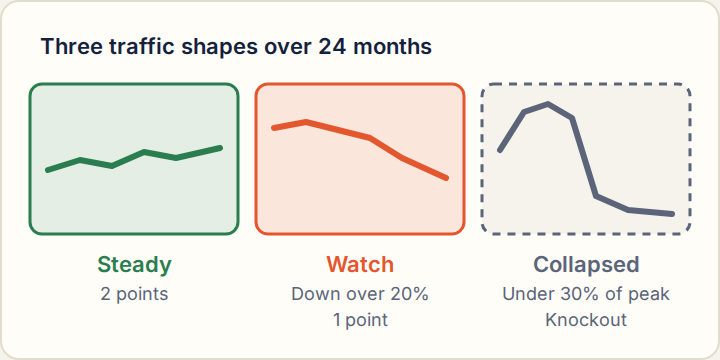
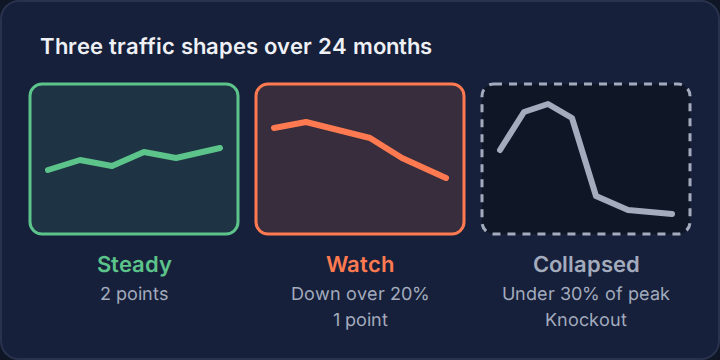
Before you fail a site on check 4, look at the same months a year earlier. Home and garden sites dip every winter. If the site is within 80% of where it was in those months last year, treat the drop as seasonal.
How often sites fail these checks
The traffic checks are the ones that catch sites which look fine. A website may have a clean design, on-topic posts and a prompt response from the owner, yet still have lost the majority of its readers.
Part 2: the ten scored checks
Each check is worth 2 points. On the starred rows, the line between 1 point and 0 (or knockout) is the threshold on our methodology page. Every other line is a rule of thumb we find workable. Move them if your niche requires it, but make the decision before you review the site, not after.
| Check | 2 points | 1 point | 0 points |
|---|---|---|---|
| 1. Traffic level* | 2,000+ visits a month | 500 to 2,000 | Knockout |
| 2. Traffic direction* | Latest 3 months within 20% of the 3 before, or seasonal | Down more than 20% | Knockout if under 30% of peak |
| 3. Keyword trend | Ranking keywords flat or rising | Falling | Knockout if under 100 |
| 4. Domain history | Continuous archive, same subject throughout | One old gap or change of subject | Recent revival: near zero a year ago, busy now |
| 5. Outbound links per post* | 8 or fewer | 9 to 15 | Over 15 |
| 6. Sponsored share* | Under 10% of the 20 newest posts | 10% to 30% | Over 30% |
| 7. Article length* | 800+ words on average | 500 to 800 | Under 500 |
| 8. Posting rate* | 12 or more posts in 12 months | 4 to 11 | 3 or fewer |
| 9. On your subject | 8 or more of the 10 newest posts | 5 to 7 | 4 or fewer |
| 10. Seller terms in writing | Permanence, rel attribute and replacement all answered | Some answered | Refuses to put anything in writing |
For checks 5 to 9, read the newest posts and count inside the article body only. Menus, footers and author boxes do not count.
Check 10 is the only one that needs the seller. Ask three questions: how long the post stays up, which rel attribute the link carries, and what happens if the link is removed. Our guide to seller terms has the full list.
Reading the score
| Score | Decision | Why |
|---|---|---|
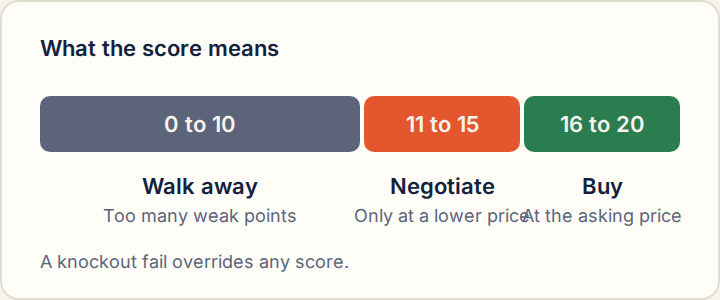
| 16 to 20 | Buy at the asking price | No more than two weak points, and nothing serious. |
| 11 to 15 | Buy only at a lower price, or pass | Several soft spots. The price should reflect them. |
| 0 to 10 | Walk away | Too many weak points for any price to fix. |
The bands are our policy, not a law. Their job is to stop you talking yourself into a site because the seller was friendly or the price was low.
A worked example
This site is invented to show the arithmetic.
| Check | What was found | Points |
|---|---|---|
| Knockouts 1 to 5 | All passed | Go on |
| Traffic level | 3,400 visits a month | 2 |
| Traffic direction | Down 24% in 3 months, not seasonal | 1 |
| Keyword trend | Flat | 2 |
| Domain history | Continuous since 2016, same subject | 2 |
| Outbound links | 11 per post | 1 |
| Sponsored share | 4 of 20 posts (20%) | 1 |
| Article length | 1,100 words | 2 |
| Posting rate | 31 posts in 12 months | 2 |
| On your subject | 9 of 10 | 2 |
| Seller terms | Permanence and rel answered, replacement not | 1 |
| Total | 16 of 20 |
By a single point, sixteen is a buy. The three single-point answers tell you what to do next: ask about replacement, and re-check traffic in a month before ordering a second post.
The order that saves money
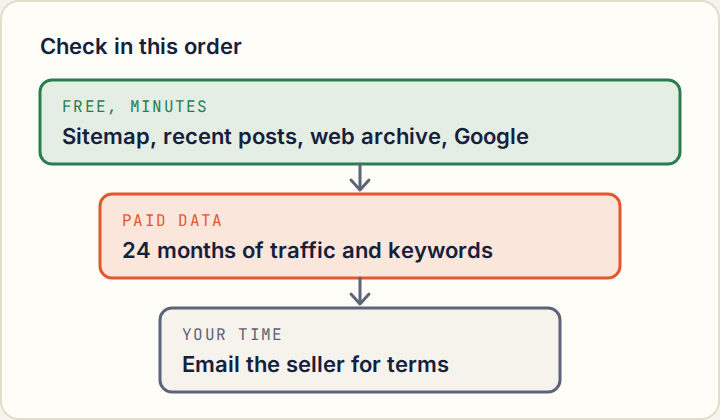
In our run, 1.8% of checked sites came through the free checks. Paying for traffic data on all of them would have meant buying data on thousands of sites that a sitemap search would have removed for nothing.
The same principle applies to your time. Do not write to a seller until the site has passed every knockout you can run without them.
What the scorecard cannot tell you
- Whether your post will be indexed. Check 5 looks at the site's recent record. Page-level indexing checks go further.
- Whether the link will stay. Ahrefs found that in about a third of lost links, the page is still live and the link was removed. Written terms and re-checks are your only defence. See the guide to how backlinks pass value.
- Whether the link is within Google's rules. Google's spam policies treat links bought for ranking purposes as link spam unless they carry rel="sponsored" or rel="nofollow". A high score does not change that.
How to check this yourself
- Set your bands first. Write down the score you will buy at before you open the site.
- Run knockouts 1, 2 and 5. They are free: load the site, search the sitemap, and search Google for three recent post addresses.
- Pull 24 months of traffic and keywords for the sites still standing, and run knockouts 3 and 4.
- Read the 10 newest posts and score checks 5 to 9 as you go.
- Look the domain up in the web archive for check 4. Look at one capture per year.
- Email the seller the three terms questions and score check 10 from the reply.
- Add it up and apply the band you wrote down in step 1.
- Keep the scorecard. Re-score the site before any repeat order.
Questions buyers ask
- Is a high DR or DA enough to skip the checklist?
- No. DR (Ahrefs Domain Rating) and DA (Moz Domain Authority) score a whole domain and say nothing about traffic direction, gray-topic posts or whether recent pages are indexed. None of the 15 checks uses them.
- What if the seller will not put terms in writing?
- Score check 10 as zero and count it against the total. A seller who will not confirm how long a post stays up by email has told you something about how a later dispute would go.
- Does a site that passes make a paid link safe with Google?
- No. Google classes links bought for ranking purposes as link spam unless they carry rel="sponsored" or rel="nofollow". The scorecard reduces wasted spend. It does not change the policy.
- How often should I re-score a site?
- Before every repeat order, and at once if the site changes owner, design or subject. Traffic and content can fluctuate within a few months.
Related guides
Sources
Last updated Methodology