How links work
Anchor text best practice: why the words around the link matter

Buyers spend a long time choosing an anchor and almost none on the sentence it sits in. That is the wrong way round. An anchor is two or three words. The sentence and the article around it are what tell a reader, and a search engine, what the link is about.
This guide gives the confirmed guidance, what the 2024 leak adds, and worked examples.
What Google says
Confirmed by Google
Google's link best practices page says anchor text tells people and Google something about the page being linked to. It describes good anchor text as descriptive, reasonably concise, and relevant to the page it is on and the page it links to.
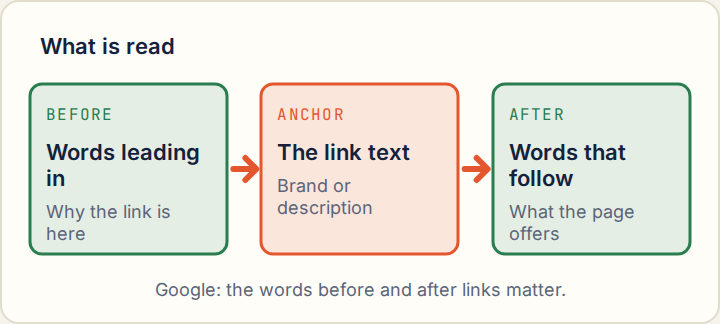
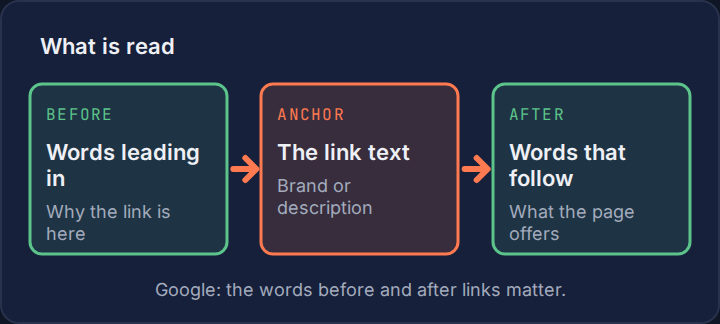
The same page tells writers that the words before and after links matter, to pay attention to the sentence as a whole, and not to chain links next to each other, because each link then loses its surrounding text.
Indicated by the 2024 documentation leak
Google documentation that became public in 2024 lists attributes for the text near a link, described by analysts as the left and right context, alongside the anchor itself. They also report an attribute that suggests links can be demoted when anchor and target do not match.
Our inference
Confirmed guidance and the leak point the same way: a link is read in its setting. We take from this that a relevant sentence in a relevant article does more than a keyword anchor in an unrelated one. The weights are not known.
Anchor types
| Type | Example | When to use |
|---|---|---|
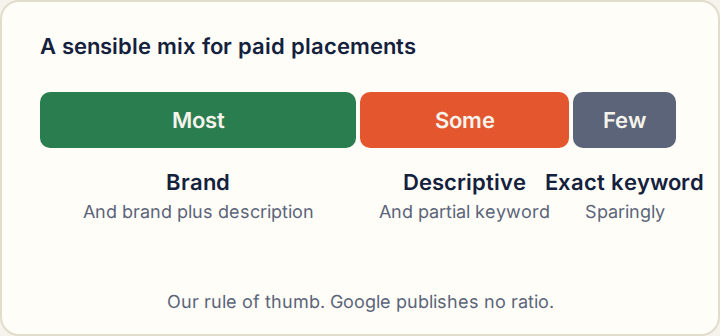
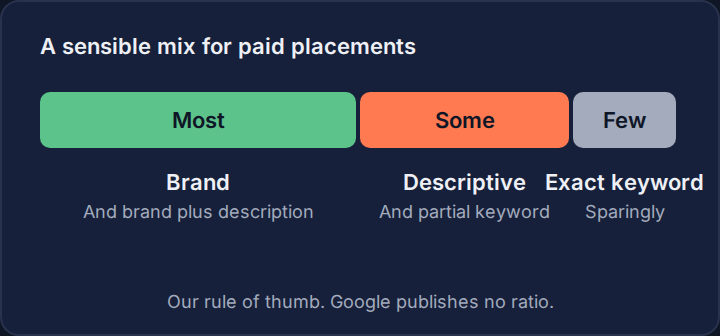
| Brand | Acme Lofts | Most of the time. How people link when nobody is paying. |
| Brand plus description | Acme Lofts, a Leeds insulation installer | Often. Good for readers and for being named. |
| Descriptive | this guide to loft insulation costs | Often. Tells the reader what they get. |
| Partial keyword | insulating a loft conversion | Sometimes. Reads naturally in the right sentence. |
| Exact keyword | loft insulation Leeds | Rarely. Reads as paid. |
| Naked address | acmelofts.example | Sometimes. Common in citations and resource lists. |
| Generic | click here, read more | Never. Google's page lists these as bad examples. |
Worked examples
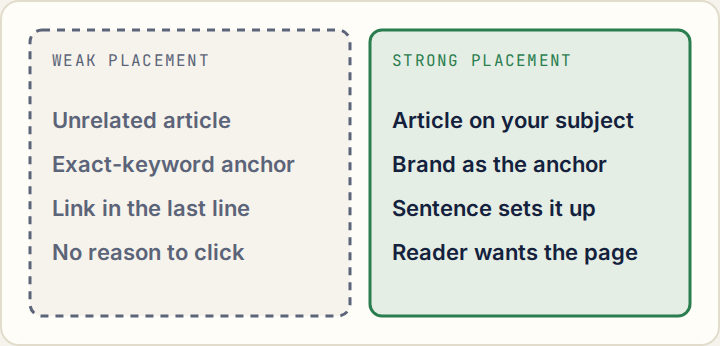
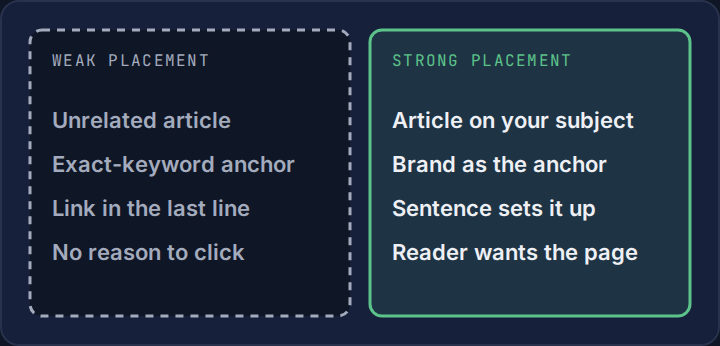
Weak. An article about holiday packing tips ends: "For the best loft insulation Leeds, click here."
- The article has nothing to do with insulation.
- The anchor is an exact keyword with a location bolted on.
- No reader of a packing article wants that link.
Better. An article about cutting winter heating bills says: "The biggest single loss in most houses is through the roof. Acme Lofts, an installer in Leeds, publishes measured heat-loss figures for each job, which gives a sense of what topping up insulation actually saves."
- The article is on the subject.
- The sentence before the link sets up why it is there.
- The anchor is the brand, and the words after it describe the page.
- A reader who cares about the point has a reason to click.
Anchors and paid links
A site's links normally arrive with messy, varied anchors: the brand, the address, "this article", the author's name. A profile where most anchors are the same commercial keyword looks arranged, because it was.
Google's spam policies treat links bought for ranking purposes as link spam unless they carry rel="sponsored" or rel="nofollow". Careful anchor choice does not change that. It only avoids making a paid link obvious to readers and wasteful for you. The policy guide covers the risk.
What sellers decide
What to ask a seller
| Question | Why |
|---|---|
| Who writes the sentence around the link? | If they do, ask to see it before it goes live. |
| Can I choose the anchor? | Some sellers allow brand anchors only. |
| Will the anchor or link be changed later? | Get "no changes without asking" in writing. |
| Where in the article will it go? | First half of the body, not the author box. |
| Can the brand be named in the text? | A named brand is worth having in its own right. |
How to write a guest post readers click shows how to build the article around the link, and seller terms in writing has the full question list.
How to check this yourself
- Open the article your link is in. Is it about your subject?
- Read the sentence before the link. Does it give a reason for the link?
- Read the anchor on its own. Would a reader know what is behind it?
- Read the sentence after. Does it describe your page or just move on?
- List the anchors of all your paid links. If one keyword dominates, change course.
- For new placements, write the whole sentence yourself and send it with the order.
Questions buyers ask
- What is the best anchor text for a backlink?
- Usually your brand name, or a short plain description of the page. Google describes good anchor text as descriptive, reasonably concise and relevant to both pages.
- Is exact-match anchor text bad?
- Not in itself, and it occurs naturally now and then. Used on most of your paid links it forms a pattern that looks arranged.
- Does the text around a link matter?
- Yes. Google's link guidance says the words before and after links matter and advises paying attention to the whole sentence.
Related guides
Sources
- Google Search Central: link best practices
- Search Engine Land: links and digital PR takeaways from the Google documentation leak
- Google Search Central: spam policies for Google web search
Last updated Methodology