After the link goes live
How to monitor backlinks you paid for: a re-check schedule
A link is the only thing most businesses buy and never check again. It is also one of the easiest purchases to lose without noticing: the page stays up, your invoice is paid, and the link quietly goes.
This guide gives you a schedule, the four things to check each time, and a tracking sheet.
How links are lost
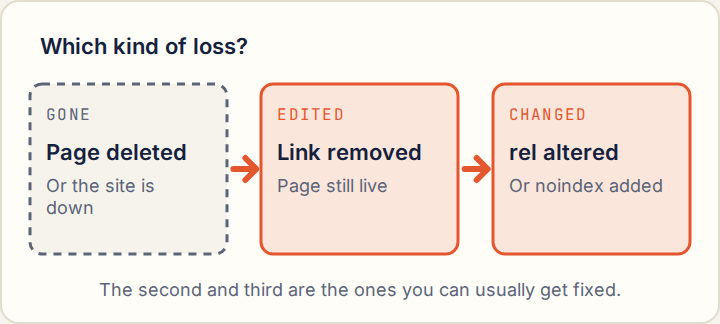
Ahrefs sampled the links pointing to 2,062,173 websites from January 2013 onward. It found 66.5% had rotted, and 74.5% were lost for ranking purposes once errors and other faults were counted. It also classified why links are lost.
- Page or domain dropped
- 47.7%
- Link removed, page still live
- 34.2%
- Crawl error
- 6.45%
- Redirected
- 5.99%
- Not found
- 4.11%
The first bar you can do little about. The second is the one a buyer can act on: somebody edited the post. If you agreed terms and you notice in time, you can ask for it back.
The schedule
| When | Why then |
|---|---|
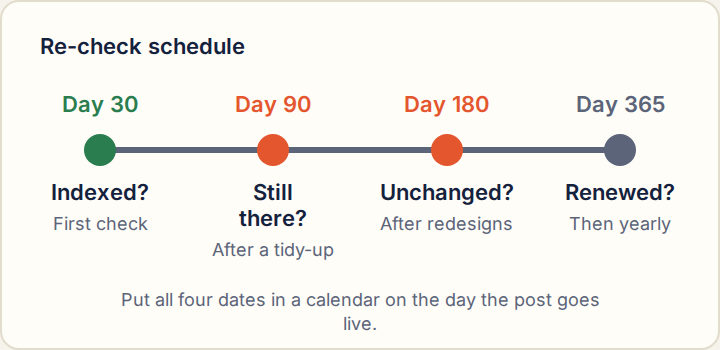
| Day 30 | The post should be indexed. Early edits and broken promises show up here. See the post-placement checklist. |
| Day 90 | Sites tidy up after a quarter. The seller still remembers you. |
| Day 180 | Redesigns and theme changes strip tags and move posts. |
| Day 365 | The point where "one year" placements quietly end. |
| Yearly after that | Sites are sold, abandoned or repurposed. |
The four checks
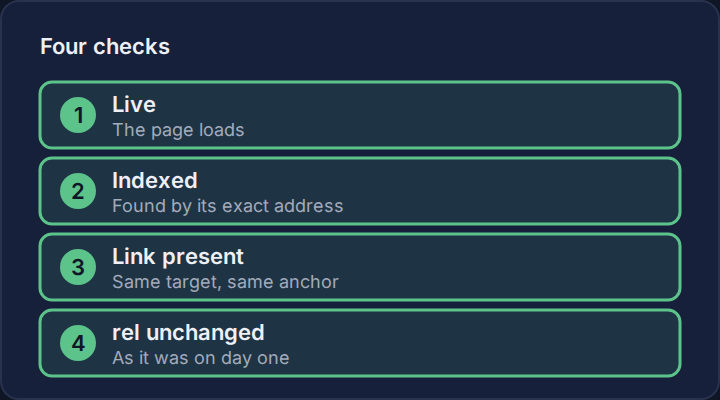
| Check | How | What a fail usually means |
|---|---|---|
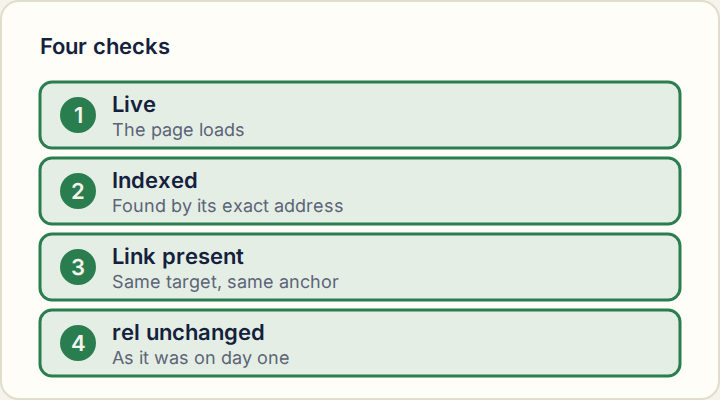
| Live | Open the address. | Post deleted, site down, or address changed. |
| Indexed | Search Google for the exact address. | A noindex tag was added, or Google dropped the page. |
| Link present | Find your link on the page and click it. | Edited out, or the article was replaced. |
| rel unchanged | View the source and read the link's rel value. | A site-wide change made outbound links nofollow or sponsored. |
Also glance at what surrounds your link. New links added beside yours, or the article cut to a paragraph, are early signs the site is turning into a link farm.
A tracking sheet
Keep one row per placement. The columns that matter: the placement address, the date it went live, what you paid, the target page, the anchor, the rel attribute on day one, the permanence agreed, the seller's contact, and a result for each of the four checks at each date.
The template below has those columns ready. It opens in any spreadsheet program.
When a spreadsheet stops working
| Number of placements | Method |
|---|---|
| Up to about 50 | Spreadsheet and calendar reminders. Ten minutes a month. |
| 50 to a few hundred | A backlink monitoring tool that re-crawls a list of addresses and alerts on change. |
| Agency scale | A tool plus a written process. See an agency QA process. |
Tools are good at "live" and "link present". Few check indexing reliably, so do that one by hand on your more expensive placements.
What we can and cannot tell you
When a check fails
Do not write an angry email first. Work out what happened, because the right message depends on it. What to do when a backlink is removed has the steps and the wording.
How to check this yourself
- Download the tracking sheet and add a row for each placement you have.
- Fill in the day-one facts: address, date, price, target, anchor, rel, terms.
- Add four calendar reminders per placement: 30, 90, 180 and 365 days.
- At each reminder, run the four checks and log the result.
- When one fails, identify the kind of loss before contacting the seller.
- Once a year, total what you paid for links that are still live and indexed, and what you paid for those that are not.
Download the tracking sheet (CSV)
Questions buyers ask
- How often should I check my backlinks?
- For paid placements: at 30, 90, 180 and 365 days, then yearly. Those dates match when changes tend to happen.
- Do I need a paid tool?
- Not for a few dozen links. A spreadsheet and reminders do the job. A tool earns its fee when you track hundreds.
- What share of paid links survive a year?
- We do not have our own figure. One 2026 audit of cheap marketplace links found about a third of the pages dead after a year, but that describes the low end of the market, not guest posts on established blogs.
Related guides
Sources
- Ahrefs: link rot study
- SpeedyIndex study of 15,389 bought backlinks, via Cantech Letter (November 6, 2026)
- BacklinkURLs methodology
Last updated Methodology